Weighted vs. Unweighted GPA: What's the Difference and How to Calculate Both
Understand the difference between weighted and unweighted GPA. Learn how 4.0 and 5.0 scales work, how AP and honors classes boost your GPA, and how to calculate both with worked examples.
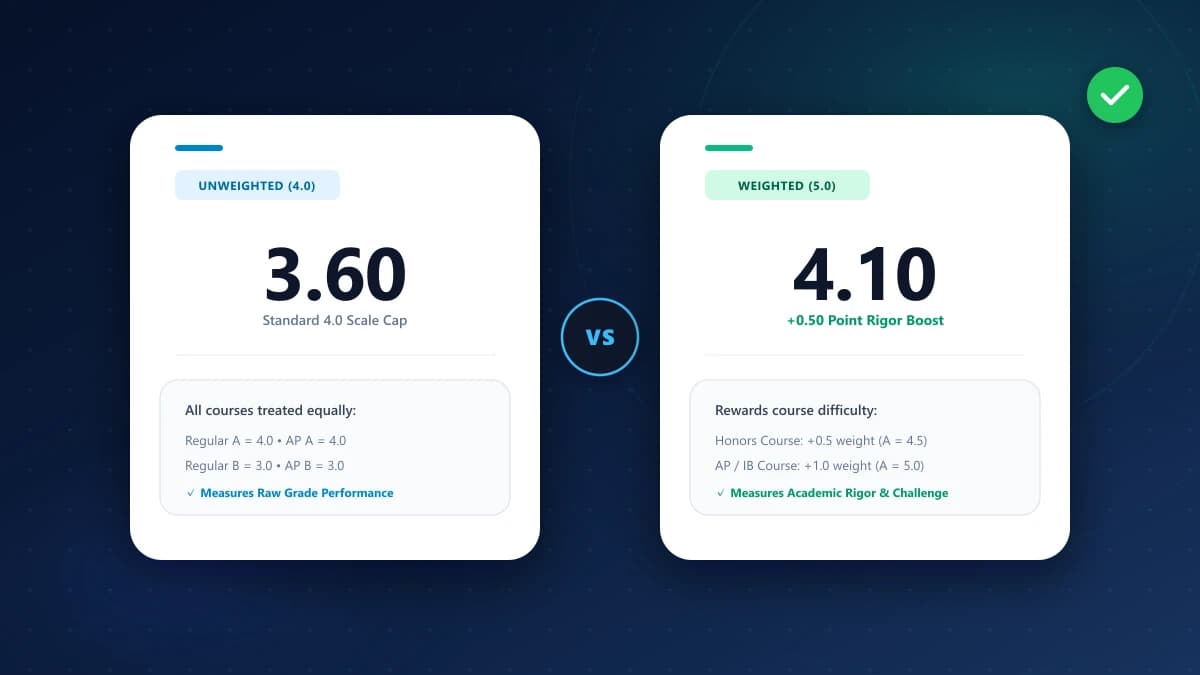
When reviewing a high school transcript or preparing a college application, few metrics cause more confusion than the presence of two different Grade Point Averages: an unweighted GPA and a weighted GPA. A student might discover they have a 3.60 unweighted GPA alongside a 4.10 weighted GPA. This raises immediate questions: Which number is the real measure of academic achievement? How are both numbers calculated? And which score do college admissions committees actually prioritize?
Understanding the distinction between weighted and unweighted GPA is essential for high school students, parents, and counselors. An unweighted GPA evaluates grades strictly on a standard 4.0 scale regardless of course difficulty, providing a pure measure of classroom performance. In contrast, a weighted GPA factors in academic challenge by adding extra grade points (typically +0.5 for Honors courses and +1.0 for Advanced Placement or International Baccalaureate courses), capping at 5.0 or higher. Neither metric tells the complete story on its own. While unweighted GPA reflects consistent mastery, weighted GPA rewards students for stepping out of their comfort zone into rigorous college-level coursework.
Whether you are calculating your current standing, planning your course load for next year, or comparing GPA to cumulative metrics across semesters using our free CoditTools CGPA Calculator, this guide breaks down the core concepts, grading scales, calculation formulas, worked examples, and admissions policies you need to know.
What is an unweighted GPA?
An unweighted GPA (Grade Point Average) is a measurement of academic performance that calculates the average of your grades on a standard scale from 0.0 to 4.0, treating every single class with equal mathematical value. Whether a course is an introductory elective, a required physical education class, or an intensive college-level AP Physics course, an 'A' earned in that class is worth exactly 4.0 grade points.
In a standard unweighted system, letter grades map to numerical points as follows:
- A (90–100%): 4.0 grade points
- B (80–89%): 3.0 grade points
- C (70–79%): 2.0 grade points
- D (60–69%): 1.0 grade point
- F (Below 60%): 0.0 grade points
Some school districts incorporate plus and minus grades (for instance, an A− might equal 3.7 and a B+ might equal 3.3), but the upper ceiling of an unweighted GPA is universally locked at 4.00. It is mathematically impossible to earn higher than a 4.0 on an unweighted scale, even if you earn straight A's in ten Advanced Placement classes.
Advantages and limitations of unweighted GPA
The primary advantage of the unweighted GPA is transparency and universal comparability. Because every school district understands a 4.0 scale, admissions officers and scholarship committees can immediately gauge whether a student earned mostly A's, B's, or C's without needing to decode district-specific weighting rules.
The core limitation, however, is that unweighted GPA completely ignores academic rigor. Under an unweighted model, a student who takes an undemanding schedule of standard courses and earns straight A's finishes with a perfect 4.00 GPA. Conversely, a student who takes the most rigorous STEM courses available and earns three A's and two B's finishes with a 3.60 GPA. Unweighted GPA on its own can unintentionally penalize students who challenge themselves with demanding curriculum.
What is a weighted GPA?
A weighted GPA is an adjusted measurement that incorporates both your letter grade and the difficulty level (rigor) of the courses you take. High schools developed weighted GPA systems specifically to encourage students to enroll in challenging honors, Advanced Placement (AP), International Baccalaureate (IB), and dual-enrollment college courses without fear of destroying their grade point average.
To reflect this added academic challenge, schools assign extra "weight" (often called quality points) to advanced classes. While a standard course caps an 'A' at 4.0, advanced courses receive an additive boost:
- Standard / College Prep Courses: Standard 4.0 scale (A = 4.0, B = 3.0, C = 2.0, D = 1.0, F = 0.0).
- Honors Courses: Typically receive a +0.5 point boost (A = 4.5, B = 3.5, C = 2.5, D = 1.5, F = 0.0).
- Advanced Placement (AP) & International Baccalaureate (IB): Typically receive a full +1.0 point boost (A = 5.0, B = 4.0, C = 3.0, D = 2.0, F = 0.0).
- Dual Enrollment / College Courses: Most districts award either a +0.5 or +1.0 boost, depending on whether the course is classified as honors or equivalent to college-level AP.
Because of these extra points, a weighted GPA can rise significantly above 4.0, commonly reaching up to 5.0 in districts that use a 5.0 scale. Some specialized high schools or regional districts use 6.0, 7.0, or even 100-point percentage-weighted scales. Because weighting systems vary so widely from district to district, there is no single universal weighted GPA formula across all United States high schools.
Weighted vs. unweighted GPA: key differences
To see how these two systems compare side by side, review the primary structural differences below:
| Feature | Unweighted GPA | Weighted GPA |
|---|---|---|
| Scale Range | 0.0 to 4.0 (strictly capped at 4.00) | 0.0 to 5.0 (can reach 5.3+ or 6.0 depending on school scale) |
| Course Rigor Considered? | No. All classes carry identical weight. | Yes. Honors (+0.5) and AP/IB (+1.0) receive extra points. |
| What It Evaluates | Raw classroom achievement and consistency. | Willingness to take advanced, college-level curriculum. |
| Failing Grades (F) | 0.0 grade points. | 0.0 grade points (no rigor bonus awarded for failing). |
| Class Rank Use | Rarely used alone for competitive class rank. | Standard basis for determining valedictorian and class rank. |
| College Admissions Focus | Evaluated as the universal baseline. | Evaluated alongside high school course profile and school context. |

How to calculate unweighted GPA by hand
Calculating your unweighted GPA is straightforward because you do not need to account for course difficulty. If all your courses carry equal credit value (for example, 1.0 credit per course), the unweighted GPA is simply the arithmetic mean of your grade points.
Step-by-step unweighted formula
- Convert every letter grade to standard 4.0 points: Assign 4.0 for an A, 3.0 for a B, 2.0 for a C, 1.0 for a D, and 0.0 for an F.
- Sum the grade points: Add all converted points together.
- Divide by the number of courses: Divide the total points by the total count of classes taken.
In mathematical notation, when courses have identical credit weight:
Unweighted GPA = (Sum of All Grade Points) / (Total Number of Courses)
If your school awards fractional credits (such as a 0.5-credit semester elective or a 1.5-credit science course with a lab), multiply each grade point by the course credit hours to obtain quality points, sum those quality points, and divide by total credits earned. You can verify semester percentages against standard score cutoffs using our CoditTools Percentage Calculator.
How to calculate weighted GPA by hand
Calculating a weighted GPA requires an extra classification step: you must identify which classes are standard, honors, or AP/IB, and add the appropriate quality point weights before averaging.
Step-by-step weighted formula
- Identify the rigor category for each course: Note whether each class is Standard (College Prep), Honors, or AP/IB.
- Determine the school's weighting values: Under the most common 5.0 system, standard classes add +0.0, honors classes add +0.5, and AP/IB classes add +1.0.
- Assign weighted grade points: For example, an A in Honors Pre-Calculus receives 4.5 points (4.0 base + 0.5 boost), and an A in AP Chemistry receives 5.0 points (4.0 base + 1.0 boost).
- Check for failing grades: Remember that an F receives 0.0 points in virtually all districts; schools do not give an extra point for failing an AP class.
- Sum the weighted points and divide: Add all weighted points together and divide by the total number of classes.
Weighted GPA = (Sum of Weighted Grade Points) / (Total Number of Courses)
Worked examples with step-by-step calculations
To see how the math works in practice, let us examine two complete real-world scenarios. All calculations below are verified independently.
Worked Example 1: Same semester, direct side-by-side comparison
Consider an 11th-grade student taking five courses in a single semester. We assume standard grading where A = 4.0, B = 3.0, C = 2.0, with a +0.5 honors weight and a +1.0 AP weight. All courses carry equal 1.0 credit weight.
| Course Name | Level | Grade | Unweighted Points | Weighted Points |
|---|---|---|---|---|
| English 11 | Regular | A | 4.0 | 4.0 (+0.0) |
| AP U.S. History | AP | B | 3.0 | 4.0 (+1.0) |
| Honors Pre-Calculus | Honors | A | 4.0 | 4.5 (+0.5) |
| AP Chemistry | AP | A | 4.0 | 5.0 (+1.0) |
| Spanish III | Regular | B | 3.0 | 3.0 (+0.0) |
| Total Points | 5 Courses | 3 A's, 2 B's | 18.0 | 20.5 |
Now, let us calculate both outcomes:
- Unweighted GPA:
18.0 / 5 = 3.60 - Weighted GPA:
20.5 / 5 = 4.10
Analysis: On paper, the unweighted GPA is 3.60, representing a solid mix of A's and B's. But the weighted GPA is 4.10—a full +0.50 points higher. The weighted score immediately highlights to an evaluator that the student took two rigorous AP classes and an honors course, achieving high marks in demanding subjects.

Worked Example 2: Unequal credit hours and lab courses
In many high schools and colleges, courses do not all carry the same credit value. When credit values differ, calculations must use quality points (credits multiplied by grade points). To track this over multiple semesters, consult our detailed guide on GPA vs CGPA and how cumulative averages are calculated.
Suppose a senior takes three courses with varying credits:
- English 12 (Regular, 1.0 credit): Grade A (4.0 base points). Quality Points = 1.0 × 4.0 = 4.0 (Unweighted) / 1.0 × 4.0 = 4.0 (Weighted).
- AP Physics C + Lab (AP, 1.5 credits): Grade A (4.0 base points, 5.0 weighted points). Quality Points = 1.5 × 4.0 = 6.0 (Unweighted) / 1.5 × 5.0 = 7.5 (Weighted).
- U.S. Government (Honors, 0.5 semester credit): Grade B (3.0 base points, 3.5 weighted points). Quality Points = 0.5 × 3.0 = 1.5 (Unweighted) / 0.5 × 3.5 = 1.75 (Weighted).
Let us sum the credits and quality points:
- Total Credits:
1.0 + 1.5 + 0.5 = 3.0 credits - Total Unweighted Quality Points:
4.0 + 6.0 + 1.5 = 11.5 - Total Weighted Quality Points:
4.0 + 7.5 + 1.75 = 13.25
Final Calculations:
- Unweighted GPA:
11.5 / 3.0 = 3.833... ≈ 3.83 - Weighted GPA:
13.25 / 3.0 = 4.416... ≈ 4.42
Notice how the 1.5-credit AP Physics class exerts a larger gravitational pull on the overall GPA than the 0.5-credit Government course. When credits differ, courses with higher credit weights matter more to your final standing.
How AP, honors, and advanced courses affect GPA
Advanced coursework influences your high school record in several distinct ways:
1. Honors courses (+0.5 weight)
Honors classes cover material faster and in greater depth than standard college prep courses. They prepare students for the demands of Advanced Placement classes. Because the workload is higher, schools usually reward an honors grade with a 0.5-point boost. An 'A' becomes a 4.5, and a 'B' becomes a 3.5.
2. Advanced Placement (AP) & International Baccalaureate (IB) (+1.0 weight)
AP courses are audited by the College Board and follow standardized college-level syllabi. At the end of the year, students can take nationwide AP exams scored from 1 to 5; scoring a 3, 4, or 5 often earns college credit or advanced placement at university. Because AP classes represent bona fide college work, high schools grant a full 1.0-point bump (an 'A' is worth 5.0). IB courses follow a rigorous international curriculum and generally receive the identical +1.0 weight.
3. Dual enrollment (College in High School)
Dual-enrollment courses are actual college classes taken through a local community college or four-year university while in high school. Grading policies vary: some districts treat dual enrollment as honors (+0.5), while others treat it as AP equivalent (+1.0) because the course appears on an accredited college transcript.
4. The zero-point fail rule
Students often wonder: "If I take an AP class and get an F, do I get 1.0 point?" The answer is universally no. High schools only award rigor weights to passing grades (D or higher, and in many competitive districts, only C or higher). An F is 0.0 points in regular, honors, and AP classes alike.
The big dilemma: AP with a 'B' vs. regular with an 'A'
One of the most frequent questions asked by high school students and parents during course selection is: "Is it better to get a 'B' in an AP class, or an 'A' in a regular class?"
Let us look at the mathematical reality first, and then the admissions reality.
The mathematical comparison
Assume a student takes four other classes with standard grades (totaling 15.0 unweighted points and 16.5 weighted points):
- Scenario A (Regular Class, Earns 'A'): Adding 4.0 points gives 19.0 unweighted (GPA = 3.80) and 20.5 weighted (GPA = 4.10).
- Scenario B (AP Class, Earns 'B'): Adding 3.0 unweighted / 4.0 weighted points gives 18.0 unweighted (GPA = 3.60) and 20.5 weighted (GPA = 4.10).
Notice that the weighted GPA is identical at 4.10 in both scenarios! The extra point in the AP class exactly offsets the drop from an A to a B in the weighted calculation. However, the unweighted GPA drops from 3.80 down to 3.60.

The college admissions perspective
College admissions officers are frequently asked this dilemma. The famous tongue-in-cheek response from top admissions deans is: "We prefer you get an 'A' in the AP class."
Humor aside, when forced to choose between a 'B' in AP and an 'A' in regular, selective and competitive colleges almost always prefer the 'B' in the AP course. Here is why:
- Proof of college readiness: Earning a B in college-level AP Calculus or AP English Literature demonstrates that you can read complex texts, analyze data, and handle rigorous examinations. An 'A' in an unchallenging course only proves that you can master standard high school material.
- Holistic review: Admissions officers do not merely look at your GPA number; they inspect your actual transcript line by line to evaluate your curriculum within the context of what your high school offers.
- The cautionary limit: While an AP 'B' is respectable, a 'C' or 'D' in an AP class hurts your application significantly. If an AP class is so overwhelming that you are at risk of earning below a B−, you are generally better served taking honors or regular coursework. If you are trying to calculate what scores you need on remaining exams to keep your grade in the B range, use our free CoditTools Grade Calculator.
Which GPA do colleges actually consider?
A common misconception among high school seniors is that college admissions offices simply sort applicants by their high school weighted GPA. In reality, the process is far more nuanced.
1. Why colleges recalculate GPAs
Because there are over 20,000 high schools in the United States alone—each using its own weighting formulas, honors classifications, and scale caps (some cap at 4.5, some at 5.0, some at 6.0)—a 4.3 GPA at School A might represent the same performance as a 3.8 at School B. To create a level playing field, most competitive colleges recalculate your GPA on their own standardized scale.
2. The standardized recalculation methods
- Core Academic Courses Only: Many public university systems and private institutions strip out non-academic electives (such as physical education, driver's education, health, and chorus) and recalculate an unweighted GPA strictly using English, math, science, social studies, and foreign languages.
- The UC GPA (University of California): The University of California system uses its own specific formula based on 10th and 11th-grade A–G courses. They calculate an unweighted UC GPA, a capped weighted UC GPA (which allows a maximum of 8 semesters of honors/AP extra points), and a fully weighted UC GPA.
- Standardized Unweighted 4.0: Many universities convert all applicant transcripts back to a standard 4.0 unweighted baseline to evaluate raw performance, and then use your School Profile to assess how challenging your courseload was relative to what your school offered.
3. Context is king
Colleges receive a document from your guidance counselor called the School Profile. It details how many AP/IB courses your school offers, what percentage of students go to four-year colleges, and whether your school weights grades. If your school only offers three AP classes and you took all three, colleges recognize that you took maximum advantage of your environment. You are not penalized for not taking AP courses that your high school did not offer.
Is a higher weighted GPA always better?
While a higher weighted GPA is generally positive, chasing weighted points at all costs can backfire if not managed carefully:
- Academic burnout and sleep deprivation: Enrolling in five AP courses simultaneously can lead to exhaustion, diminishing returns on homework quality, and lower test scores across all subjects.
- Compromising core grades: If an intense AP courseload causes your grades to slip from A's to C's, your unweighted GPA will plummet, and college admissions readers will question your course selection judgment.
- Sacrificing extracurricular depth: College admissions are holistic. Spending four hours every night on busywork for an elective AP class at the expense of leadership in robotics, athletics, community service, or work experience can weaken your overall applicant profile.
Common GPA calculation mistakes to avoid
When calculating their own GPAs, students frequently make these common errors:
- Mistake 1: Adding weighted bonus to a failing grade (F). An F is 0.0 grade points regardless of whether the course is regular, honors, or AP. There are no "weighted Fs."
- Mistake 2: Assuming all colleges accept your school's weighted number. Relying solely on your high school's 4.8 weighted GPA without knowing your unweighted score can lead to unrealistic college list expectations. Always know both numbers.
- Mistake 3: Ignoring credit values. Treating a 0.5-credit semester class the same as a 1.0-credit year-long class distorts your average. Always use credit-weighted quality points when course credits vary. For semester-by-semester credit weighting, see our tutorial on how to calculate CGPA with credit hours.
- Mistake 4: Confusing GPA with CGPA. A GPA typically refers to a single term or academic year, whereas CGPA (Cumulative Grade Point Average) represents your entire high school or college career across multiple terms.
How to calculate your GPA and track academic standing on CoditTools
Tracking your grades should not require tedious hand calculations every marking period. CoditTools provides free, browser-based academic utilities designed for students, educators, and parents:
- CoditTools CGPA Calculator: Compute your cumulative credit-weighted GPA across multiple semesters, terms, and credit allocations. Runs 100% locally in your browser with zero data sent to external servers.
- CoditTools Grade Calculator: Calculate your current course grade, model weighted category scores (homework, labs, midterm, final), and determine the exact score needed on your final exam to lock in an A or B.
- CoditTools Percentage Calculator: Quickly convert test scores, marks, and grade boundaries into exact percentages and fractional weights.
Frequently asked questions
What is considered a good weighted GPA?
Because weighted GPA scales vary, "good" depends on your school's scale and target colleges. On a standard 5.0 weighted scale, a 3.5 to 3.9 weighted GPA is considered solid for many four-year colleges. A weighted GPA of 4.0 or higher indicates you earned predominantly A's and B's in honors or AP courses and is competitive for selective universities.
Can your weighted GPA be lower than your unweighted GPA?
No. Under standard school policies, weighted GPA cannot be lower than your unweighted GPA. Advanced courses either add extra points (+0.5 or +1.0) or, in the case of regular courses, add +0.0. Unless a school district employs an unusual penalty system for remedial courses, your weighted GPA will always be equal to or higher than your unweighted GPA.
What is the highest possible weighted GPA?
On a traditional 5.0 weighted scale, the highest possible theoretical GPA is 5.00, which occurs if a student takes 100% AP or IB classes and earns straight A's in every single one. In practice, because high schools require standard physical education, health, and elective classes that carry no weight, top valedictorian weighted GPAs typically max out between 4.50 and 4.80.
Is an unweighted 4.0 better than a weighted 4.3?
It depends on course context. A student with an unweighted 4.0 achieved through basic, non-honors classes may be viewed as less competitive by selective colleges than a student with a 3.8 unweighted / 4.3 weighted GPA who took eight rigorous AP courses. Competitive colleges value academic challenge and want to see students pushing themselves in core subjects.
Do honors classes boost your GPA as much as AP classes?
Usually no. In most American high schools, honors classes receive a +0.5 quality point boost (A = 4.5), while AP (Advanced Placement) and IB (International Baccalaureate) courses receive a full +1.0 boost (A = 5.0). However, some private schools and districts treat honors and AP identically or use custom school scales.
How do colleges compare students from schools with different GPA scales?
Admissions offices use two main tools: recalculation and the School Profile. Many universities recalculate every applicant's GPA using a standardized unweighted formula based only on core academic subjects. They also read the high school's profile report to see how many honors/AP courses the school offered and where the student ranks within their graduating class.
Conclusion
Both weighted and unweighted GPAs serve distinct, complementary purposes on your academic journey. Your unweighted GPA acts as the universal benchmark of classroom mastery on a clean 4.0 scale, while your weighted GPA tells the story of your intellectual ambition—demonstrating that you were willing to embrace demanding honors and AP coursework.
When planning your high school courseload, do not focus on chasing points alone. Strive for a balanced schedule that challenges you in your strongest academic subjects while allowing you to maintain strong grades, participate in meaningful extracurricular activities, and protect your personal well-being. For instant grade projections and cumulative multi-semester calculations, explore the free tools in the CoditTools Student Tools Suite.
Try the tools mentioned in this post - all free, no account needed.
Runs in your browser. No watermarks. No file uploads to a server.
Browse math calculators →