BMI Calculator: Formula, Ranges and Where BMI Misleads
The BMI formula with worked examples, how to enter pounds and inches, the WHO ranges, and where BMI misleads: muscle, fat distribution, age and Asian populations.
BMI (body mass index) is your weight in kilograms divided by your height in metres squared. For an adult, the result is read against fixed ranges: under 18.5 is below the normal range, 18.5 to 24.9 is the normal range, 25 to 29.9 is overweight and 30 or more is obese. It is a quick screening number based only on height and weight, so it can't tell you how much of your weight is fat, where it sits, or whether you are healthy.
This guide shows the calculation with worked examples, how to enter pounds, feet and inches (the CoditTools BMI Calculator works in centimetres and kilograms), how its healthy-weight range is derived, and where BMI misleads. It is general information, not medical advice.
How BMI is calculated
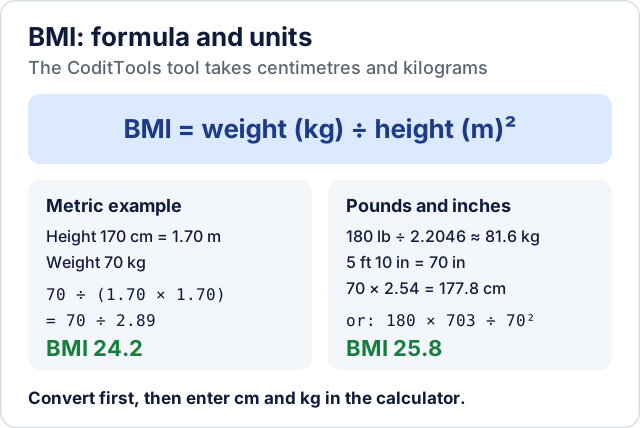
BMI = weight (kg) ÷ height (m)²A person who is 170 cm (1.70 m) tall and weighs 70 kg has a BMI of 70 ÷ (1.70 × 1.70) = 70 ÷ 2.89 = 24.2. The same weight at 160 cm gives 70 ÷ 2.56 = 27.3. Height is squared, so a few centimetres of difference changes the result noticeably.
If you use pounds, feet and inches
The CoditTools calculator has two boxes, Height (cm) and Weight (kg), and no unit switch, so convert first:
- pounds ÷ 2.2046 = kilograms (180 lb ≈ 81.6 kg)
- (feet × 12 + inches) × 2.54 = centimetres (5 ft 10 in = 70 inches ≈ 177.8 cm)
That example (180 lb, 5 ft 10 in) comes to a BMI of 25.8. If you would rather calculate by hand in pounds and inches, the formula is weight in pounds × 703 ÷ height in inches squared: 180 × 703 ÷ 70² = 126,540 ÷ 4,900 = 25.8, the same answer.
What the categories mean
For adults the World Health Organization's international ranges are the standard, and the CoditTools calculator uses them:
| BMI | Category shown by the tool |
|---|---|
| Below 18.5 | Underweight |
| 18.5 to 24.9 | Normal |
| 25.0 to 29.9 | Overweight |
| 30.0 and above | Obese |
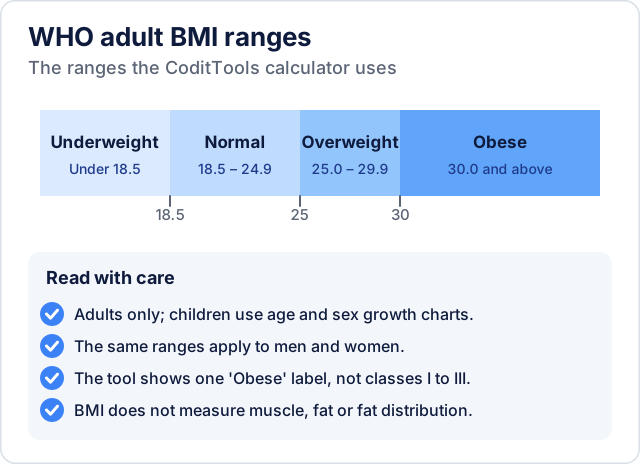
Medical references usually divide obesity further into classes I (30–34.9), II (35–39.9) and III (40 and above); the calculator shows only the single "Obese" label. The same ranges apply to men and women, and to any adult age.
The healthy weight range and "Target Change"
Besides the BMI and category, the calculator reports the weight range that would put you between BMI 18.5 and 24.9 at your height, and how far your weight is from it:
| Height and weight | BMI | Healthy weight range for that height | Target Change shown |
|---|---|---|---|
| 170 cm, 70 kg | 24.2 (Normal) | 53.5 – 72.0 kg | Healthy range |
| 160 cm, 70 kg | 27.3 (Overweight) | 47.4 – 63.7 kg | Lose 6.3 kg |
| 170 cm, 50 kg | 17.3 (Underweight) | 53.5 – 72.0 kg | Gain 3.5 kg |
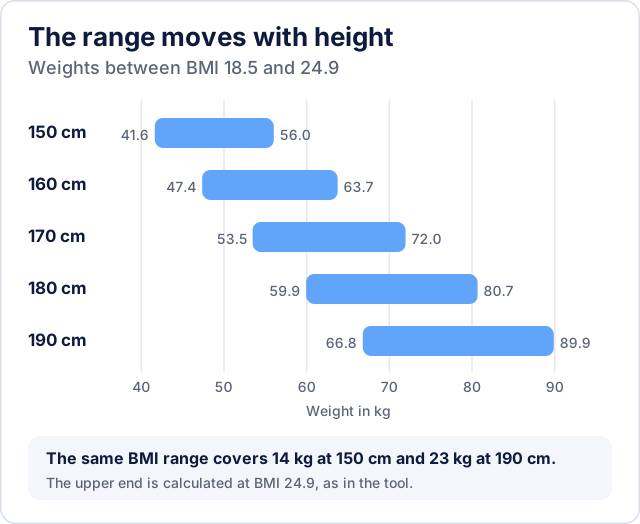
Treat "Target Change" as arithmetic, not as a recommendation. It is the weight at which the BMI formula would land you at the edge of the range; it takes no account of your muscle, age, health conditions or what is realistic and safe for you. The range is also very wide: at 170 cm it spans about 18.5 kg.
Where BMI misleads
- It can't distinguish muscle from fat. A strength athlete can have a BMI in the overweight range with little body fat, and someone with little muscle can have a "normal" BMI and still carry a lot of fat.
- It ignores where fat is stored. Fat around the abdomen is associated with higher risk than the same amount elsewhere, which is why waist circumference is often measured as well.
- It was built for adults. Children and teenagers are assessed with growth charts that compare BMI with other children of the same age and sex, so the adult ranges above do not apply under 18.
- Risk differs between populations. The standard ranges above are international ones. Research on Asian populations has found that the risk of conditions such as type 2 diabetes can already be raised at BMIs below 25, and some health authorities use lower cut-offs for these groups. If this applies to you, ask your doctor or your national health guidance which ranges to use.
- Older adults, pregnancy, and some medical conditions change what a healthy BMI looks like, and the standard ranges are not designed for them.
Using BMI sensibly
BMI is most useful as one data point that you track over time with the same scale. A number outside the normal range is a reason to look at the other measures (waist circumference, blood pressure, blood tests, fitness and how you feel) and, if you are concerned, to talk to a doctor or dietitian; it is not a diagnosis. A normal BMI is not proof of good health either.
If you want a calorie estimate for planning, the TDEE calculator estimates how many calories you burn per day (using the Mifflin-St Jeor formula) from your sex, age, height, weight and activity level. The health tools category also has ideal weight, calorie, water intake and pregnancy calculators. Like BMI, these are estimates based on formulas, and none of them replaces advice from a health professional.
Try the tools mentioned in this post - all free, no account needed.
Runs in your browser. No watermarks. No file uploads to a server.
Browse math calculators →