How to Calculate CGPA: Formula, Credit Hours, GPA to CGPA & Examples
Learn how to calculate CGPA with step-by-step formulas, credit-hour weightings, GPA to CGPA conversions, Excel guides, and worked university examples.
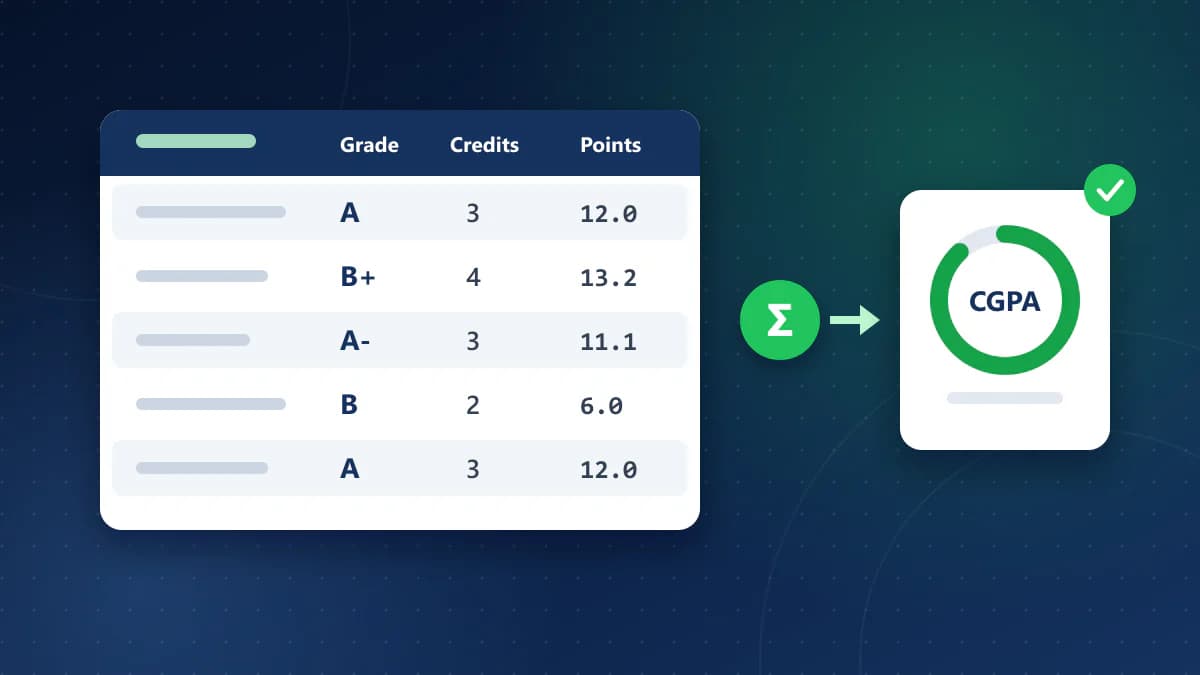
Cumulative Grade Point Average (CGPA) is the primary metric universities, scholarship committees, and graduate admissions use to measure your overall academic standing. Unlike a simple average of test scores, understanding how to calculate a cgpa requires knowing how course grades combine with individual credit hour weights across every completed semester.
If you have ever tried to calculate your cumulative average by simply averaging your semester GPAs together, you may have noticed that your result does not match your official academic transcript. This discrepancy happens because semesters rarely carry identical credit loads. A heavy 18-credit term influences your cumulative average significantly more than a lighter 12-credit term.
This guide explains the complete mathematics of CGPA calculation. You will learn the core weighted formula, how credit hours affect your standing, how to calculate cgpa from gpa values or individual courses, how to build a cgpa calculator excel model, and how different grading scales (such as 4.0, 5.0, and 10.0 UGC scales) work in practice.
What Is CGPA?
CGPA stands for Cumulative Grade Point Average. It represents the weighted average of all grade points you have earned across all subjects, courses, and semesters throughout an academic degree program.
To understand CGPA clearly, it helps to distinguish between three related terms used in higher education:
- GPA (Grade Point Average): A generic term referring to the average grade points earned over any defined set of courses.
- SGPA (Semester Grade Point Average): The grade point average earned strictly within a single academic term, quarter, or semester.
- CGPA (Cumulative Grade Point Average): The overall grade point average accumulated across all completed semesters from the start of your degree up to the present date.
The defining characteristic of CGPA is that it is credit-weighted. Instead of treating every class equally, university grading systems weigh each subject proportionally based on its assigned credit hours. A 4-credit calculus course has four times the mathematical weight of a 1-credit laboratory workshop.
The CGPA Formula
A standard mathematical formula commonly used by universities and colleges to compute cumulative grade point average is:
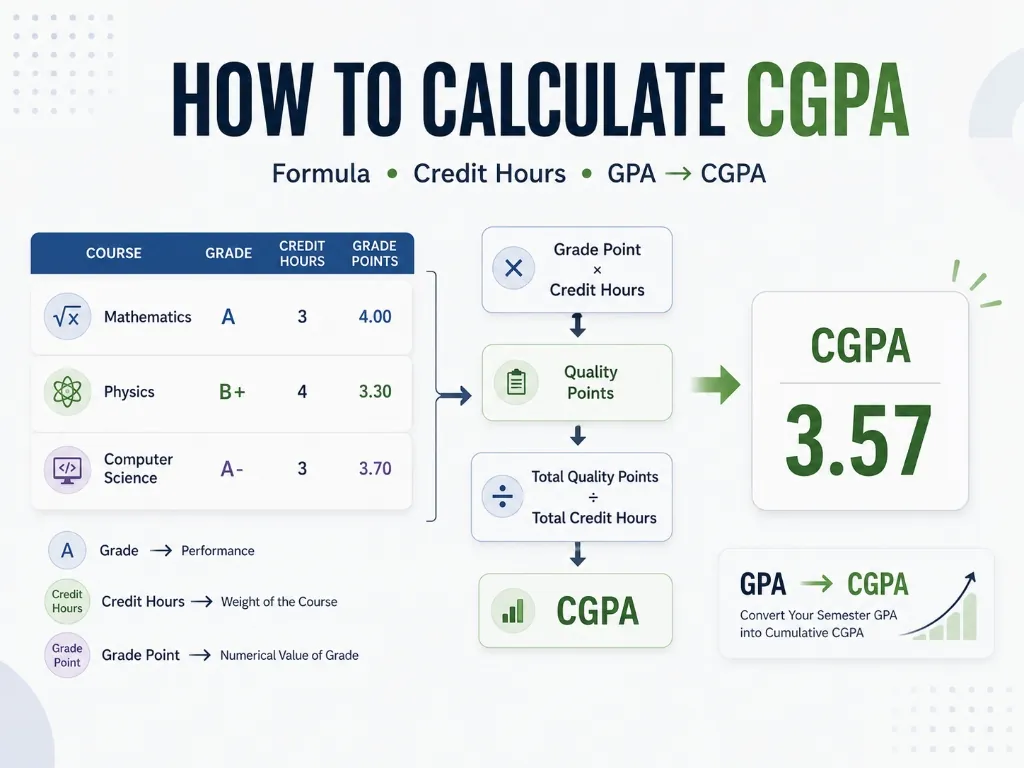
CGPA = Total Quality Points Earned / Total Credit Hours Attempted
Where Quality Points for each course = Grade Point × Credit Hours
Written in formal mathematical summation notation:
Breaking Down the Formula Components
- Letter Grade: The qualitative evaluation awarded by your professor (such as A, B+, C, or F).
- Grade Point: The numerical value assigned to that letter grade based on your institution's grading scale (for example, on a standard 4.0 scale, an A equals 4.0 and a B equals 3.0).
- Credit Hours: The measure of workload or instructional time assigned to the course (typically 1 to 5 credits per subject).
- Quality Points (Grade Points Earned): The product obtained by multiplying the course's grade point by its credit hours. For instance, earning an A (4.0) in a 3-credit course yields
4.0 × 3 = 12.0quality points. - Total Credit Hours: The sum of all credit hours across all evaluated courses.
How to Calculate CGPA Step by Step
To calculate your CGPA manually from individual courses, follow this four-step process:
- Identify your course grades and credit hours: List every course completed along with its earned letter grade and official credit weighting from your syllabus.
- Convert letter grades into numeric grade points: Match each letter grade against your university's official scale (e.g., standard 4.0 scale).
- Calculate quality points for each course: Multiply each course's numeric grade point by its credit hours.
- Divide total quality points by total credit hours: Add up the quality points for all courses and divide that number by the sum of all credit hours.
Step-by-Step Numerical Walkthrough (Single Semester)
Consider a student enrolled in four courses during a semester under a standard 4.0 grading scale:
| Course Name | Credit Hours | Letter Grade | Grade Point | Quality Points (Credits × Grade Point) |
|---|---|---|---|---|
| Programming Fundamentals | 3 | A | 4.0 | 3 × 4.0 = 12.0 |
| Calculus I | 4 | B+ | 3.3 | 4 × 3.3 = 13.2 |
| Technical Writing | 3 | A- | 3.7 | 3 × 3.7 = 11.1 |
| Physics Laboratory | 1 | A | 4.0 | 1 × 4.0 = 4.0 |
| Total | 11 Credits | - | - | 40.3 Quality Points |
Using the formula:
Semester GPA = Total Quality Points / Total Credit Hours = 40.3 / 11 = 3.6636... ≈ 3.66
The student earned a semester GPA (SGPA) of 3.66 across 11 credit hours.
How Credit Hours Affect CGPA
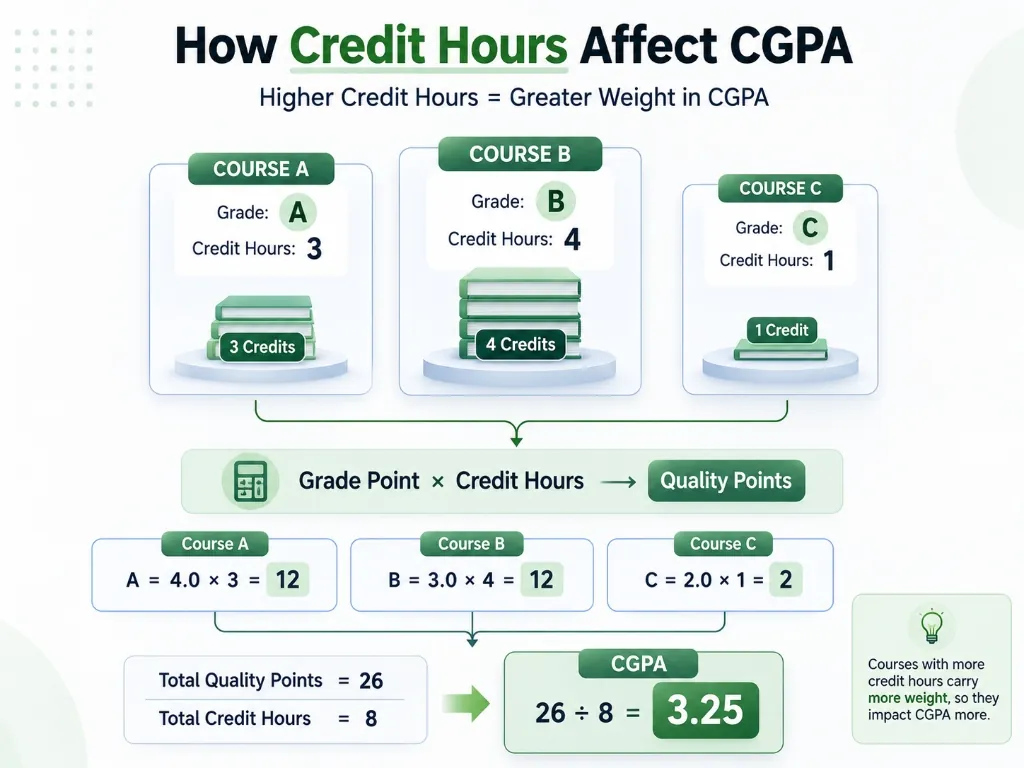
One of the most frequent misconceptions students have is assuming that all courses influence their GPA equally. In reality, credit hours serve as mathematical weights. A high grade in a heavy course boosts your GPA substantially, while a poor grade in a low-credit course does relatively little damage.
Simple Average vs. Credit-Weighted Average: The Mathematical Difference
To see why credit hours matter, consider what happens if you calculate a simple arithmetic average instead of a credit-weighted average for the following two courses:
- Organic Chemistry: 5 credit hours, Grade C (2.0 points)
- Introductory Seminar: 1 credit hour, Grade A (4.0 points)
The Incorrect Simple Average Method:
Simple Average = (2.0 + 4.0) / 2 = 3.00
The Correct Credit-Weighted Method:
- Organic Chemistry quality points:
5 × 2.0 = 10.0 - Introductory Seminar quality points:
1 × 4.0 = 4.0 - Total Quality Points =
10.0 + 4.0 = 14.0 - Total Credits =
5 + 1 = 6 True Weighted GPA = 14.0 / 6 = 2.33
The simple average produced 3.00, while the actual university GPA is 2.33. The difference of 0.67 grade points occurs because the 5-credit Chemistry class accounts for 83.3% of the total academic workload that term. Always use credit hours when calculating your GPA or cumulative CGPA.
How to Calculate CGPA from Semester GPA
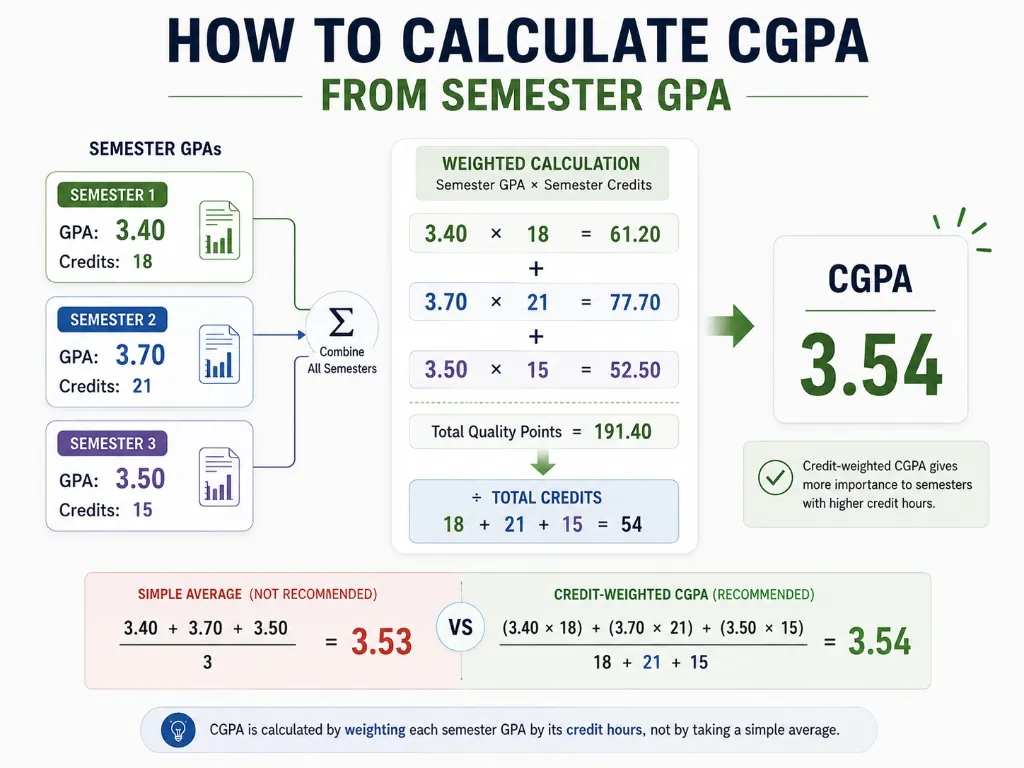
Students frequently wonder how to calculate cgpa from gpa numbers when their student portal provides term-by-term summaries rather than raw course assignments. Instead of re-entering every single course from previous years, you can calculate your cumulative CGPA directly from your semester GPAs using the weighted semester formula:
Cumulative CGPA = Σ (Semester GPA × Semester Credits) / Total Degree Credits
This method forms the core of an online gpa to cgpa calculator mode. It multiplies each semester's GPA by its credit hours to recover total semester quality points, sums them across all terms, and divides by your cumulative credit hours.
Worked Example: Combining 3 Semesters with Different Credit Loads
| Academic Term | Semester GPA (SGPA) | Semester Credit Hours | Weighted Quality Points (GPA × Credits) |
|---|---|---|---|
| Semester 1 (Freshman Fall) | 3.80 | 18 | 3.80 × 18 = 68.4 |
| Semester 2 (Freshman Spring) | 3.00 | 12 | 3.00 × 12 = 36.0 |
| Semester 3 (Sophomore Fall) | 3.50 | 16 | 3.50 × 16 = 56.0 |
| Cumulative Totals | - | 46 Total Credits | 160.4 Total Quality Points |
Calculation:
Cumulative CGPA = 160.4 / 46 = 3.4869... ≈ 3.49
If you had made the common mistake of simply averaging the three semester GPA numbers (3.80 + 3.00 + 3.50) / 3, you would have gotten 3.43. The accurate weighted CGPA is 3.49 because your highest performance (3.80 GPA) occurred during your heaviest semester (18 credits).
How to Calculate CGPA in University
Understanding how to calculate cgpa in university requires knowing that while the underlying mathematics remains consistent, higher education institutions implement specific academic guidelines that affect your final standing:
- Course Evaluation & Letter Grades: At the conclusion of a term, your exam scores, coursework, and practical assessments are converted into an official letter grade.
- Credit Registration: Every course has a defined credit value approved by the university academic council (e.g., 3 credits for standard lecture courses, 4 credits for lab-inclusive courses).
- Pass/Fail & Audit Exclusions: Most universities exclude binary Pass/Fail, Satisfactory/Unsatisfactory, and audited courses from GPA calculations. These courses award credit toward graduation requirements if passed, but carry 0 quality points and are omitted from the GPA denominator.
- Course Repeats & Academic Forgiveness: When a student repeats a course, some universities completely replace the previous grade with the new grade, while others average both attempts together. Consult your university registrar for your institution's specific repeat policy.
- Degree Classification: Your final cumulative CGPA determines academic honours at graduation (such as Summa Cum Laude, Magna Cum Laude, First Class with Distinction, or Dean's Honour Roll). Using a dependable university cgpa calculator helps you track these milestones accurately.
How to Calculate CGPA in Excel or Google Sheets
Spreadsheet applications make it easy to track coursework and learn how to calculate cgpa in excel or Google Sheets without manual arithmetic. Setting up a structured template gives you a persistent record of your academic history throughout your degree.
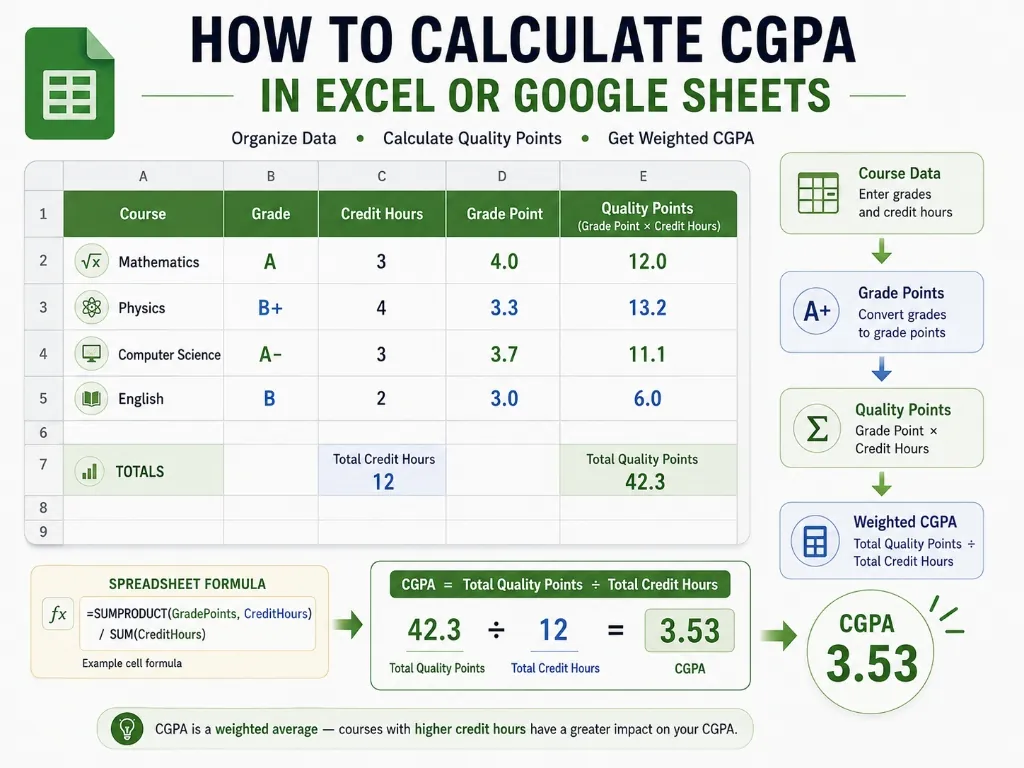
Setting Up Your Spreadsheet Columns
- Column A: Course Name (e.g.,
A2: "Data Structures") - Column B: Credit Hours (e.g.,
B2: 4) - Column C: Grade Point (e.g.,
C2: 4.0) - Column D: Quality Points (Formula in
D2: =B2*C2)
Drag the formula in Column D down for all your course rows (e.g., rows 2 through 6).
Essential Spreadsheet Formulas
To compute total credits, total quality points, and overall CGPA:
- Total Credit Hours (Cell B7):
=SUM(B2:B6) - Total Quality Points (Cell D7):
=SUM(D2:D6) - Calculated CGPA (Cell D8):
=D7/B7
The Single-Formula SUMPRODUCT Method
If you want to calculate your CGPA directly in one cell without creating an extra Quality Points column, you can use Excel's native SUMPRODUCT formula:
=SUMPRODUCT(B2:B6, C2:C6) / SUM(B2:B6)
The SUMPRODUCT function multiplies each course's credit hours (B2:B6) by its grade point (C2:C6) in memory and sums the products before dividing by the total credits.
If you already have your course roster saved in a spreadsheet, you can copy the rows and paste them directly into the online CGPA calculator using the "Paste from Excel" feature to import your courses instantly without manual re-typing.
CGPA Calculation on Different Grading Scales
Grading systems vary across countries, universities, and educational boards. When using any calculator or performing manual arithmetic, ensure you are referencing the specific scale used by your academic institution.
| Grading Scale System | Standard Range | Common Regions / Institutions | Representative Grade Points |
|---|---|---|---|
| 4.0 Scale (Standard) | 0.00 to 4.00 | United States, Canada, International Universities | A = 4.0, A- = 3.7, B+ = 3.3, B = 3.0, C = 2.0, D = 1.0, F = 0.0 |
| 5.0 Scale | 0.00 to 5.00 | Select European, Asian, and African Universities | A+ = 5.0, A = 4.5, B+ = 4.0, B = 3.5, C+ = 3.0, D = 2.0, F = 0.0 |
| 10.0 Scale (UGC / 10-Point) | 0.00 to 10.00 | India (CBSE, UGC, Engineering Universities) | O (Outstanding) = 10.0, A+ = 9.0, A = 8.0, B+ = 7.0, B = 6.0, C = 5.0, P = 4.0, F = 0.0 |
When selecting a cgpa calculator 4.0 scale, 5.0 scale, or 10-point scale option, the tool maps your letter grades to the corresponding numeric points automatically. The CoditTools CGPA Calculator supports standard 4.0, 5.0, and 10.0 UGC grading options. Because institutions may implement specific intermediate grade boundaries (such as assigning 4.33 for A+ or 3.25 for B+), custom passing marks, or specialized rounding rules, students should always verify that their department's official handbook matches the selected grading rubric.
5 Worked CGPA Calculation Examples
Example 1: Single-Semester Course Calculation (4.0 Scale)
A student finishes three courses: Database Systems (3 credits, Grade A = 4.0), Discrete Math (3 credits, Grade B = 3.0), and Web Engineering (4 credits, Grade A- = 3.7).
- Quality points:
(3 × 4.0) + (3 × 3.0) + (4 × 3.7) = 12.0 + 9.0 + 14.8 = 35.8 - Total credits:
3 + 3 + 4 = 10 - Semester GPA:
35.8 / 10 = 3.58
Example 2: Multiple Semesters with Equal Credit Hours
A student completes two 15-credit semesters, earning a 3.80 SGPA in Semester 1 and a 3.20 SGPA in Semester 2.
- Semester 1 points:
15 × 3.80 = 57.0 - Semester 2 points:
15 × 3.20 = 48.0 - Total quality points =
57.0 + 48.0 = 105.0over 30 total credits. - Cumulative CGPA:
105.0 / 30 = 3.50
Example 3: Multiple Semesters with Unequal Credit Hours
Semester 1: 18 credits with 3.70 GPA. Semester 2: 12 credits with 3.10 GPA.
- Semester 1 points:
18 × 3.70 = 66.6 - Semester 2 points:
12 × 3.10 = 37.2 - Total points =
66.6 + 37.2 = 103.8across 30 total credits. - Cumulative CGPA:
103.8 / 30 = 3.46(whereas a simple average would yield 3.40).
Example 4: GPA-to-CGPA Calculation Across 4 Degree Semesters
A student has completed four semesters with the following transcript records:
- Term 1: 16 credits, 3.60 GPA (57.6 points)
- Term 2: 18 credits, 3.40 GPA (61.2 points)
- Term 3: 15 credits, 3.80 GPA (57.0 points)
- Term 4: 17 credits, 3.50 GPA (59.5 points)
- Total quality points =
57.6 + 61.2 + 57.0 + 59.5 = 235.3 - Total credit hours =
16 + 18 + 15 + 17 = 66 - Cumulative CGPA:
235.3 / 66 = 3.5651... ≈ 3.57
Example 5: 10-Point Scale (UGC Engineering Calculation)
A student completes four engineering subjects under the 10.0 UGC system: Microprocessors (4 credits, Grade O = 10.0), Signals & Systems (4 credits, Grade A+ = 9.0), Control Systems (3 credits, Grade A = 8.0), and Seminar (1 credit, Grade B+ = 7.0).
- Quality points:
(4 × 10.0) + (4 × 9.0) + (3 × 8.0) + (1 × 7.0) = 40.0 + 36.0 + 24.0 + 7.0 = 107.0 - Total credits:
4 + 4 + 3 + 1 = 12 - SGPA / CGPA:
107.0 / 12 = 8.9166... ≈ 8.92
How to Plan a Target CGPA
If you want to know the average GPA you must earn in your remaining semesters to graduate with a specific CGPA, rearrange the formula to solve for the required future GPA:
Required Future GPA = [ (Target CGPA × Final Total Credits) - Current Quality Points ] ÷ Remaining Credits
Target Calculation Example
- Current standing: 60 completed credits with a CGPA of 3.10 (
60 × 3.10 = 186.0quality points). - Total degree requirement: 120 credits, so
120 - 60 = 60credits remain. - Target graduation CGPA: 3.50 (an honours cut-off).
- Quality points needed at graduation:
120 × 3.50 = 420.0 - Quality points still required:
420.0 - 186.0 = 234.0 - Required average GPA over the remaining 60 credits:
234.0 / 60 = 3.90
This is a planning estimate. If the required GPA comes out above the maximum on your grading scale, the target cannot be reached with the credits that remain, and your university's own grading rules and course availability decide your actual standing.
Common CGPA Calculation Mistakes to Avoid
- Averaging semester GPAs without credit weights: As shown earlier, simple averages distort your CGPA whenever semester credit loads vary. Always multiply each term's GPA by its credit hours.
- Using weekly class contact hours instead of credit hours: Class schedules sometimes list 4 weekly contact hours for a course that officially carries only 3 academic credits. Always use the credit hours listed on your degree syllabus.
- Applying the wrong grade point table: Using a generic 4.0 scale when your university awards 3.5 for a B+ (instead of 3.3) or uses a 5.0 system will produce inaccurate numbers.
- Mixing different grading scales: If you transferred from an institution that used a 10.0 scale to one that uses a 4.0 scale, do not combine raw numeric GPAs without official institutional credit conversion.
- Leaving out early or difficult semesters: Cumulative CGPA reflects your entire academic history at the institution. Omitting lower grades gives an inaccurate estimate of your true academic standing.
- Including audited or non-credit courses: Zero-credit workshops or audited subjects should not be added to the credit denominator.
- Assuming a universal percentage conversion formula: There is no universal formula to convert CGPA to percentage. For example, while some Indian institutions use
Percentage = CGPA × 9.5, others useCGPA × 10or dedicated institutional tables. Always check your university's official conversion certificate.
GPA vs. SGPA vs. CGPA: Comparison Table
| Academic Metric | What It Measures | Time Scope | Calculation Basis | Primary Purpose |
|---|---|---|---|---|
| GPA (Grade Point Average) | General average of grade points earned | Variable (course set, major courses, or term) | Quality points divided by credit hours | General academic assessment across specific course groups |
| SGPA (Semester GPA) | Performance strictly within one academic semester or term | Single semester / term | Semester quality points divided by semester credits | Term-by-term evaluation, Dean's List eligibility, term standing |
| CGPA (Cumulative GPA) | Overall performance across all completed semesters | Full degree program to date | Total cumulative quality points divided by total cumulative credits | Degree classification, graduation honors, graduate school admissions |
When Should You Use an Online CGPA Calculator?
While knowing the manual formula helps you understand how grades work, using an online gpa and cgpa calculator saves time and prevents calculation mistakes. Here are practical situations where using a calculator is especially beneficial:
- Verifying Transcript Accuracy: Check your university portal's end-of-term calculation to ensure all credit weights and grade points were applied correctly.
- Target Grade Planning: Enter your current cumulative CGPA and experiment with hypothetical grades in upcoming semesters to see what is required to reach an honours threshold (e.g., 3.50 for Cum Laude).
- Quick GPA-to-CGPA Conversion: Combine multiple past semester GPAs in seconds without re-entering dozens of individual courses.
- Bulk Spreadsheet Import: If you maintain an academic tracker in Excel or Google Sheets, you can paste entire semester rosters into the CoditTools CGPA Calculator to compute your weighted standing instantly.
- Exploring Single-Term Performance: If you only need to compute your current term standing, you can also cross-reference individual term grades with a dedicated GPA calculator.
For related guides, see GPA vs CGPA: what is the difference and how to convert CGPA to percentage.
Frequently Asked Questions
How do I calculate CGPA?
To calculate CGPA, multiply each course's numeric grade point by its credit hours to calculate quality points. Add all quality points across all completed semesters and divide by the total number of credit hours attempted: CGPA = Total Quality Points / Total Credit Hours.
How do I calculate CGPA from GPA?
To calculate cumulative CGPA from semester GPAs, multiply each semester's GPA by its total credit hours, sum those products across all semesters, and divide by the total cumulative credits: Cumulative CGPA = Σ (Semester GPA × Semester Credits) / Total Credits.
Can I average my semester GPAs to get CGPA?
Only if every semester carried the exact same number of credit hours. If your credit hours varied from semester to semester (e.g., 18 credits in Fall and 14 credits in Spring), simply averaging your semester GPAs will produce an inaccurate result. You must use a credit-weighted calculation.
How do credit hours affect CGPA?
Credit hours serve as mathematical weights. A 4-credit course contributes four times as much to your GPA as a 1-credit course. High grades in heavy courses raise your CGPA significantly, while low grades in high-credit courses pull your average down more quickly.
How do I calculate CGPA in Excel?
In Excel, list credit hours in Column B and grade points in Column C. In Column D, enter =B2*C2 to compute quality points for each row. Sum Column D (total points) and Column B (total credits), then divide points by credits (=SUM(D2:D6)/SUM(B2:B6)). Alternatively, use the single formula: =SUMPRODUCT(B2:B6, C2:C6)/SUM(B2:B6).
What is the difference between GPA, SGPA, and CGPA?
GPA is a general term for grade point average. SGPA (Semester Grade Point Average) measures your performance in a single term, while CGPA (Cumulative Grade Point Average) measures your combined academic performance across all completed semesters in your degree.
Is the 4.0 CGPA scale universal?
No. While the 4.0 scale is widely used in the United States, Canada, and many international universities, other institutions grade on a 5.0 scale, a 10.0 UGC scale (common in India), or percentage-based systems. Always confirm which scale your institution uses.
Can CGPA be converted to percentage?
There is no universal formula to convert CGPA to percentage because conversion methods vary by educational board and institution. For example, some Indian universities multiply 10-point CGPA by 9.5, while others use different formulas or published conversion tables. Always refer to your university's official conversion guidelines.
Try the tools mentioned in this post - all free, no account needed.
Runs in your browser. No watermarks. No file uploads to a server.
Browse math calculators →