How to Calculate the Grade Needed on Your Final Exam: Formulas, Worked Examples, and Edge Cases
Calculate what score you need on your final exam to pass or reach your target grade. Learn the formula, follow worked examples, and use our free calculator.

When finals week approaches, knowing your current course average is only half the battle. If your syllabus assigns 30%, 40%, or even 50% of your total course grade to a single comprehensive exam, an 85% course average going into exam week does not automatically guarantee you will finish with a B. Depending on how heavily that final is weighted, a difficult exam could drop your grade an entire letter band, while a strong performance could elevate you into an A.
A finals calculator is an algebraic projection tool that works backward from your desired course outcome. Instead of guessing how an exam score might alter your standing, it calculates the minimum percentage—and the exact number of raw points—you must earn on your final assessment to achieve your target final grade.

Quick Answer: How Do I Calculate the Grade I Need on My Final Exam?
To determine what score you need on your final exam, you need three numbers from your course syllabus and student grade portal:
- Your Target Grade (
Gtarget): The overall course percentage you want to finish with (e.g., 70% for a C, 80% for a B, or 90% for an A). Note that specific letter-grade cutoffs depend on your school and syllabus rubric. - Your Current Grade (
Gcurrent): Your weighted percentage average across all coursework completed so far. - The Final Exam Weight (
Wfinal): The percentage of your total course grade that the final exam represents (expressed as a decimal, such as 0.30 for a 30% final).
Use the standard final grade calculation formula:
Required Final Exam Score = [Target Grade − (Current Grade × (1 − Final Weight))] ÷ Final WeightQuick Calculation Example: Suppose your current running average is 82% (0.82), your desired course grade is 80% (0.80) to secure a B, and your final exam is worth 30% (0.30):
- Calculate the weight of completed work:
1 − 0.30 = 0.70(70% of the course is done). - Multiply your current grade by completed weight:
0.82 × 0.70 = 0.574(57.4 earned points toward the course total). - Subtract earned points from your target:
0.80 − 0.574 = 0.226(22.6 points needed from the exam). - Divide by the final exam weight:
0.226 ÷ 0.30 = 0.7533or 75.4%.
You must score at least 75.4% on your final exam to finish with an 80% course grade.
The Finals Calculator Formula Explained
To understand why this formula works, consider how college and high school instructors compute semester grades. In a weighted grading system, your overall course grade is the sum of every category's score multiplied by that category's proportional weight:
Final Course Grade = (Completed Work Contribution) + (Final Exam Contribution)
If the final exam represents weight Wfinal, then all previous assignments, lab reports, quizzes, and midterm exams make up the remaining weight: (1 − Wfinal). Setting your final course grade equal to your desired target produces the basic linear equation:
Gtarget = [Gcurrent × (1 − Wfinal)] + (Required Score × Wfinal)
Isolating the required final score produces the standard formula used by university academic success centers across North America.
Understanding the Variables and Conventions
| Variable | Symbol | Decimal | Percentage | Meaning in Your Syllabus |
|---|---|---|---|---|
| Target Grade | Gtarget | 0.70, 0.80, 0.90 | 70%, 80%, 90% | The minimum threshold required to earn your goal letter grade or pass the course. |
| Current Grade | Gcurrent | 0.754 | 75.4% | Your running average based strictly on graded coursework already evaluated. |
| Final Weight | Wfinal | 0.35 | 35% | The proportion of the overall class grade assigned to the final exam in the course syllabus. |
| Completed Weight | 1 − Wfinal | 0.65 | 65% | The proportion of the overall class grade accounted for by your coursework to date. |
The Total-Weight Points Formula (Normalized Version)
Many college syllabi do not express grades as tidy decimals, or they utilize point tallies where categories do not neatly add up to 100%. For a generalized model where course weights are whole percentage numbers (e.g., 20, 25, 35), the formula can be expressed directly in earned weight-points:
Required Percentage = [(Target × Total Weight) − Points Earned So Far] ÷ Final Exam WeightWhere:
Total Weightis the sum of all category weights in the syllabus (usually 100%).Points Earned So Far = ∑ (Assignment Percentage × Category Weight).Final Exam Weightis the final exam's weight percentage (e.g. 35%).
Worked Examples: Step-by-Step Calculations
Worked Example 1: Calculating the Score Needed to Pass a Course
Suppose you are enrolled in a college biology lecture course with the following grading rubric:
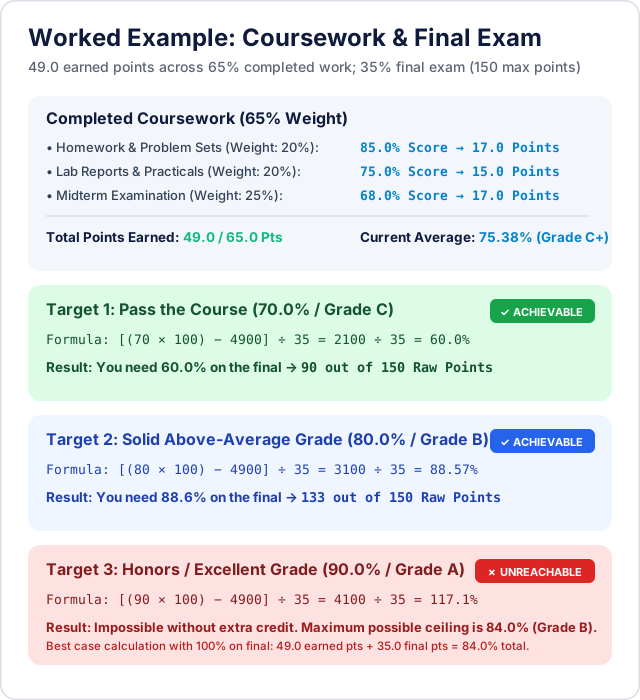
- Homework & Problem Sets: 20% of total grade. Your running average is 85.0%.
- Laboratory Practical & Reports: 20% of total grade. Your running average is 75.0%.
- Midterm Examination: 25% of total grade. You scored 68.0%.
- Comprehensive Final Examination: 35% of total grade. Scored out of 150 total test points.
Your degree program requires a minimum overall course grade of 70.0% (C) to fulfill prerequisite requirements. What score do you need on the final exam?
Step 1: Calculate Total Weight and Earned Points
The coursework completed so far accounts for:
Completed Weight = 20% + 20% + 25% = 65%
Now, calculate the weighted points contributed by each category toward your 100-point course total:
- Homework Contribution:
85.0% × 20% = 17.0 points - Lab Contribution:
75.0% × 20% = 15.0 points - Midterm Contribution:
68.0% × 25% = 17.0 points - Total Points Earned:
17.0 + 15.0 + 17.0 = 49.0 points
Step 2: Determine Your Current Standing
Before taking the final exam, your running weighted average on evaluated work is:
Current Grade = 49.0 earned points ÷ 0.65 completed weight = 75.38% (C+)
Step 3: Solve for the Required Final Exam Score
Your goal is an overall course grade of 70.0%. The final exam carries the remaining 35% weight:
Required Score = [(70.0 × 100) − 4900] ÷ 35 = [7000 − 4900] ÷ 35 = 2100 ÷ 35 = 60.0%
Result: You need exactly a 60.0% on the final exam to pass the class with a 70% C.
Converting the Percentage to Raw Exam Points
Since your instructor's final exam has a maximum score of 150 points, convert your percentage into points:
Points Needed = 60.0% × 150 points = 0.60 × 150 = 90.0 points
You must earn at least 90 out of 150 points on test day.
Worked Example 2: Aiming for a Higher Letter Grade (Securing a B or an A)
Using the exact same biology student profile (49.0 earned points across 65% completed coursework, with a 35% final exam), what score is needed to achieve higher letter bands?
Scenario A: Aiming for a B (80.0%)
Required Score = [(80.0 × 100) − 4900] ÷ 35 = [8000 − 4900] ÷ 35 = 3100 ÷ 35 = 88.57%
- Percentage Needed: 88.6%
- Raw Points on a 150-Point Exam:
0.8857 × 150 = 132.86 ≈ 133 points. - Assessment: Achievable with focused, structured revision.
Scenario B: Aiming for an A (90.0%)
Required Score = [(90.0 × 100) − 4900] ÷ 35 = [9000 − 4900] ÷ 35 = 4100 ÷ 35 = 117.14%
- Percentage Needed: 117.14%
- Assessment: Mathematically Unreachable under standard grading rules.
Even if you score a flawless 100% on the final exam, the highest grade you can mathematically attain is:
Best Possible Grade = 49.0 earned points + (1.00 × 35.0) = 84.0% (Grade B)
Recognizing this ceiling before finals week prevents wasted study time, allowing you to focus revision hours on classes where an A is still within reach.
Weighted Categories vs. Total Points Grading Systems
Before calculating your required score, verify whether your syllabus uses weighted categories or a total points system. They calculate final grades differently.
Weighted Categories Model
Assignments are grouped into percentage buckets (e.g. Quizzes 20%, Midterms 30%, Final 40%). Points earned within each category are scaled to match that category's course weight.
Formula: Proportional category weights
Total Points Model
Every assignment, quiz, and test awards raw points that add up to a fixed semester total (e.g. 600 points). An assignment's weight is determined strictly by its point value.
Formula: Direct point subtraction
How to Calculate in a Total Points Course
If your syllabus states that the entire course is worth 600 total points:
- Tally all raw points you have earned to date (for example: 410 points earned out of 460 points graded so far).
- Determine the minimum point threshold for your target grade. If an A requires 90%, you need:
0.90 × 600 = 540 total points. - Subtract your earned points from the target:
540 − 410 = 130 points needed on the final. - If the final exam is worth 140 points, your required percentage is:
130 ÷ 140 = 92.86%.
Why an Ungraded Final Must Never Be Treated as a Zero
One of the most common causes of student panic during finals week stems from how learning management systems (such as Canvas, Blackboard, or Brightspace) display running averages. Most student portals give instructors two options for gradebook displays:
- Calculate based only on graded assignments: Divides earned points by points graded to date. This accurately reflects your current performance.
- Treat unsubmitted work as zero: Divides earned points by total points possible across the entire semester.
If your professor adds a placeholder column for the final exam or configures the portal to calculate against 100% of the syllabus, your grade can appear to crash overnight—for instance, displaying as 55% instead of 85%. An upcoming final exam is an uncompleted item, not an earned zero. Until the exam is completed and evaluated, your academic standing is represented exclusively by your current weighted average. A score of zero should only be used when testing your worst-case safety net—the floor your grade would hit if you skipped the final entirely.

Interpreting Edge Cases in Finals Calculations
When you solve the final exam formula, your calculated requirement will fall into one of three distinct outcome zones:
1. Required Score is 0% or Less (≤ 0%): Target Secured
If your formula outputs a negative number or zero, your target grade is already mathematically secured. Your accumulated points on previous assignments and exams already exceed the minimum threshold needed for your goal grade. Even if you receive a zero on the final exam, your final course grade will remain at or above your target.
Important Check: Review your syllabus to confirm your instructor or department does not enforce a mandatory final exam attendance or minimum exam score policy (such as needing at least 50% on the final to pass the course regardless of course points).
2. Required Score is Between 0% and 100%: Target Achievable
This is the standard outcome for most students. Your desired grade is mathematically realistic and depends on your exam preparation. Convert the percentage into raw exam points so you know the exact point buffer you have during the test.
3. Required Score is Greater Than 100% (> 100%): Target Unreachable
If the formula yields a number above 100% (such as 108% or 117%), reaching that target grade is mathematically impossible through standard exam points alone. Even a perfect 100% test will leave your course average below the cutoff. Recalculate your requirements for the next letter grade down (e.g. targeting a solid B instead of an A) to protect your cumulative record. To understand how individual course letter grades affect your long-term academic standing across semesters, explore our in-depth guide on weighted vs. unweighted GPA.
4. Remaining Weight is 0%
If all assignments, quizzes, and exams have already been evaluated, the remaining weight is zero. Dividing by zero is mathematically undefined because the course is finished; your current grade is your permanent final grade.
5 Common Mistakes Students Make When Calculating Final Grades
- Directly Averaging Category Percentages: Averaging your 85% homework grade and your 70% midterm together directly gives 77.5%, but if homework is worth 10% and the midterm is worth 40%, your true weighted standing is
(85 × 0.10) + (70 × 0.40) ÷ 0.50 = 73.0%. Each component must be weighted according to the syllabus. - Assuming Assignment Points Equal Course Weight: A 100-point project in a 10% category contributes only 10 points to your overall course grade, while a 50-point exam in a 30% category contributes 30 points. Point totals within an assignment do not dictate course weight.
- Overlooking Departmental Final Exam Hurdles: In many university mathematics, engineering, and nursing programs, faculty regulations require students to earn at least a 50% or 60% on the final exam itself to pass the course, even if their homework average is 95%.
- Confusing Overall Grade Points with Exam Percentages: Needing 5 more percentage points on your overall course grade does not mean scoring 5% higher on your final exam. If your final is worth 25%, gaining 5 overall percentage points requires an exam score 20 percentage points higher (
5 ÷ 0.25 = 20). - Forgetting to Check Syllabus Normalization: Syllabi occasionally have weights that sum to 90% or 105% due to extra credit or omitted assignments. Always divide by the actual total weight rather than assuming a 100-point sum.
Step-by-Step Guide: Using the CoditTools Grade Calculator
To calculate your standing without solving algebraic formulas by hand, use the free browser-based CoditTools Grade Calculator. It computes your running weighted average, determines your exact final exam requirement, and projects your grade safety range.
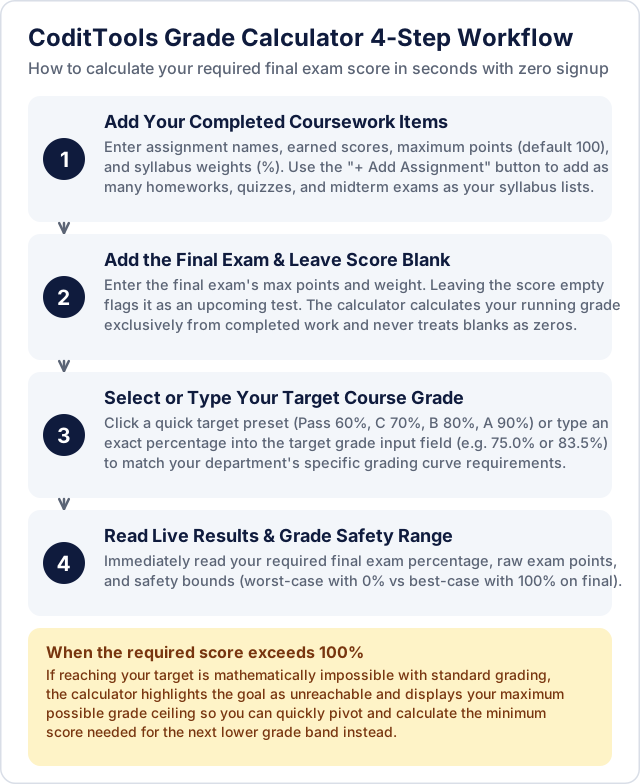
Step 1: Enter Your Completed Coursework Items
Navigate to the Grade Calculator. For each completed assignment, lab, or midterm, enter its name, your earned score, the maximum score (default is 100), and the category weight from your syllabus (e.g. Score: 80, Max: 100, Weight: 30%). Click “Add Item” to add as many assignments as needed.
Step 2: Add the Final Exam and Leave the Score Blank
Add a row for your final exam. Enter its maximum score (such as 100, 150, or 200) and its syllabus weight (such as 35% or 40%). Leave the score field completely empty. The calculator's engine automatically recognizes blank scores as upcoming work rather than treating them as zeros.
Step 3: Select or Enter Your Target Course Grade
Enter the overall percentage you wish to achieve in the “Target overall grade (%)” input, or click one of the quick presets:
- Pass (60%)
- C (70%)
- B (80%)
- A (90%)
Step 4: Review Live Calculations and Projections
The tool updates instantly in your browser without requiring a page refresh or account login:
- Current Grade: Your weighted average across evaluated work only, alongside the corresponding letter grade.
- Required Score: The exact percentage and raw point total you must score on the final exam.
- Target Status: Clear notifications indicating whether your target is Needed, Secured, or Unreachable.
- Grade Range: Your worst-case final course grade if you score 0% on the final alongside your best-case ceiling if you achieve 100%.
Verified Features and Boundaries of the Calculator
| Feature / Capability | Status | How It Operates in the Tool |
|---|---|---|
| Blank Score Handling | ✓ Supported | Classified as "remaining work" and excluded from current grade calculations. |
| Variable Exam Max Scores | ✓ Supported | Computes required raw points for 150-pt, 200-pt, or 300-pt exams automatically. |
| Weight Normalization | ✓ Supported | Normalizes category weights that do not sum to 100% across the entered total. |
| Nested Category Sub-Tasks | ✗ Not Supported | Users must calculate their category average first and enter it as a single row. |
| Drop-Lowest-Score Rules | ✗ Not Supported | Users must omit their lowest dropped assignment score before entering data. |
To track how your semester letter grades compile into your cumulative record across academic terms, cross-reference your results with our companion CoditTools GPA Calculator.
Frequently Asked Questions
How do I calculate what grade I need on my final exam?
To find what you need on your final exam, multiply your current running average by the weight of coursework completed so far, subtract that number from your target overall course grade, and divide the result by your final exam's weight. For example, if you have an 82% going into a 30% final and want an 80% overall, you need: [0.80 − (0.82 × 0.70)] ÷ 0.30 = 75.3%.
What score do I need on my final to pass with a C?
At most colleges and universities, a grade of C requires an overall course average of 70.0% (some institutions set C- at 67.0% or 68.0%). Plug 70.0% into the final grade formula as your target. If your current grade is 74% and your final is worth 30%, you need: [70 − (74 × 0.70)] ÷ 0.30 = 18.2 ÷ 0.30 ≈ 60.7% on the final exam.
What does it mean if my finals calculator says I need over 100%?
If your calculation outputs a number greater than 100% (such as 108% or 115%), reaching your target grade is mathematically impossible through standard exam grading alone. Even a perfect 100% on the final test will leave your course grade below the threshold. You should consult your instructor about extra credit or recalculate your requirements for the next achievable letter grade down.
Does a 0% required final score mean I don't have to take the exam?
Not necessarily. A required score of 0% or less means your accumulated points already guarantee your target grade under standard math. However, many colleges, academic departments, and professors maintain mandatory attendance or minimum exam passing policies that require students to take the exam or achieve a minimum score (e.g. 50%) to receive course credit.
How do I calculate my required final grade if my professor uses total points?
In a total points grading system, syllabus percentage weights are not used. Multiply the total course points by your target percentage (e.g. 0.80 × 500 = 400 points for an 80%), and subtract the total points you have earned to date. The remaining difference is the exact number of raw test points you must score on the final exam.
Why does my university portal show a different grade than my syllabus calculation?
Student portals like Canvas, Blackboard, and Brightspace often show discrepancies if instructors have not properly weighted assignment groups, if unsubmitted assignments are omitted from running totals, or if extra credit is filed under a separate unweighted category. Always verify your standing manually by checking syllabus weights against your graded assignments.
Conclusion
Calculating the score you need on your final exam turns end-of-semester uncertainty into a concrete, actionable target. Instead of stressing over worst-case scenarios, you know the exact percentage and raw test points required to pass your course, keep your scholarship, or lock in a target letter grade.
Before exam day, review your course syllabus for any prerequisite test hurdles, use the free CoditTools Grade Calculator to model your target and worst-case scenarios, and allocate your study hours where they deliver the highest impact. To monitor your long-term academic standing, explore our GPA Calculator, read our guide on weighted vs. unweighted GPA, and explore our full collection of student tools.
Try the tools mentioned in this post - all free, no account needed.
Runs in your browser. No watermarks. No file uploads to a server.
Browse math calculators →