GPA vs CGPA: What's the Difference and How Are They Calculated?
Understand the key differences between GPA, SGPA, and CGPA, including calculation periods, formulas, credit-hour weightings, transcript uses, and examples.
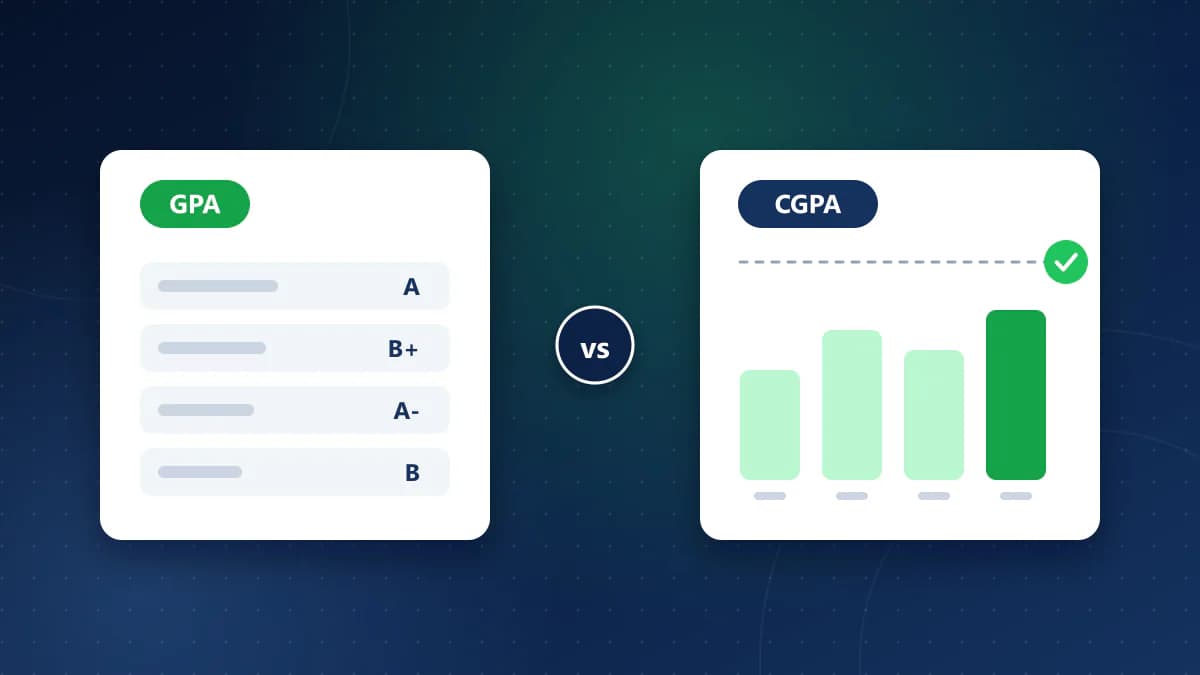
When reviewing an academic transcript, applying for scholarships, or preparing graduate school applications, students frequently encounter both GPA and CGPA. While both metrics measure academic performance using numerical grade points, they represent fundamentally different timeframes and evaluation scopes.
A common source of confusion is whether GPA and CGPA are interchangeable, which metric is more important, and how cumulative standing is derived from individual terms. Earning a high GPA in a single semester does not automatically guarantee a high cumulative CGPA if earlier semesters were challenging, and simply averaging your semester GPAs together often produces a mathematically incorrect result.
This guide provides a comprehensive comparison between GPA and CGPA. You will learn the exact mathematical distinctions, how credit hours influence both metrics, how SGPA fits into the picture, how calculations differ across grading scales, and how admissions committees and employers evaluate each figure.
GPA vs CGPA: What's the Difference?
The primary difference between GPA and CGPA is the time period and course scope evaluated:
- GPA (Grade Point Average): Measures your academic performance over a single, specific academic term (such as a semester or quarter) or within a designated subset of courses (such as major-specific GPA).
- CGPA (Cumulative Grade Point Average): Measures your overall academic performance across all completed semesters and courses throughout an entire degree program.
In short, GPA is a short-term snapshot of your academic performance in a particular term, while CGPA is your long-term cumulative record across your entire university education.
Quick Rule: GPA = Single Semester Snapshot | CGPA = Entire Degree Cumulative Record
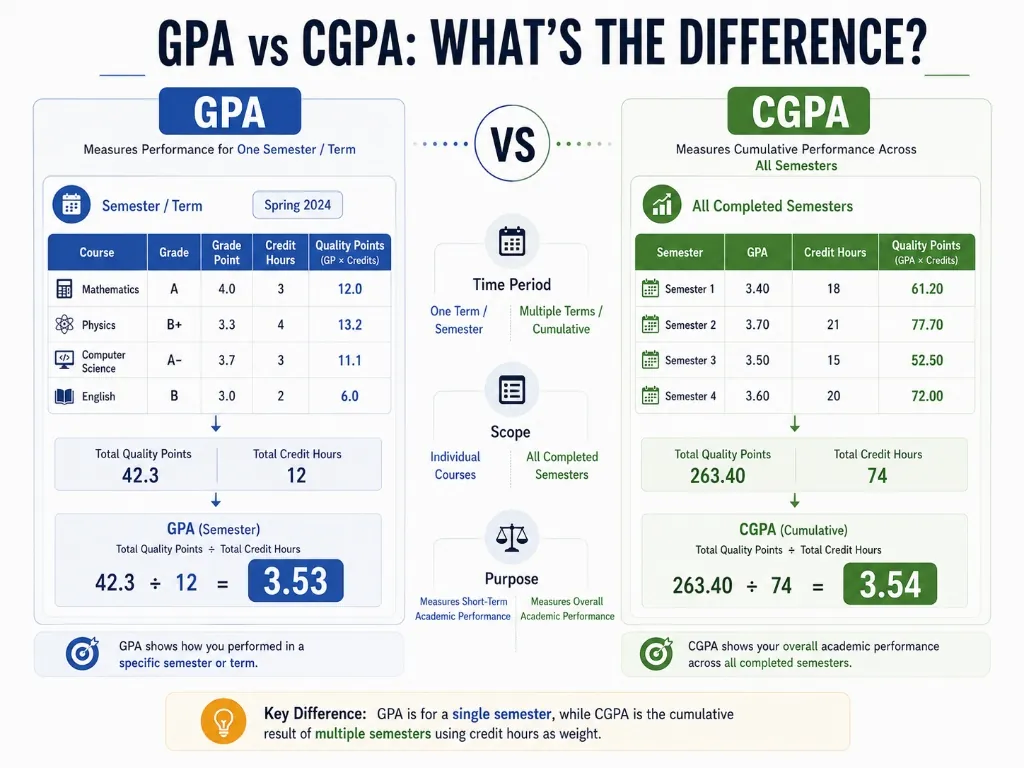
Direct Comparison Table: GPA vs CGPA
| Feature / Dimension | GPA (Grade Point Average) | CGPA (Cumulative Grade Point Average) |
|---|---|---|
| Full Form | Grade Point Average | Cumulative Grade Point Average |
| Time Scope | Single semester, term, quarter, or course block | Entire degree program from enrollment to present date |
| Update Frequency | Calculated anew at the end of each academic term | Recalculated cumulatively after each completed semester |
| Mathematical Basis | Total semester quality points divided by semester credit hours | Total cumulative quality points divided by total cumulative credit hours |
| Volatility / Sensitivity | High: Can fluctuate dramatically from term to term based on a few grades | Low: Becomes increasingly stable as total accumulated credits increase |
| Primary Purpose | Term-by-term tracking, Dean's List, semester probation checks | Graduation eligibility, degree classification, graduate school admission |
| Impact of Bad Grades | Immediate and visible in that specific term's report | Diluted across the total weight of all accumulated degree credits |
| Typical Example | 3.70 GPA in Fall Semester (15 credit hours) | 3.54 Cumulative CGPA across 5 completed semesters (75 credit hours) |
What Is GPA?
GPA stands for Grade Point Average. It is a standardized numerical representation of your academic achievement across a specific set of completed courses within a single timeframe.
In most university systems, each letter grade earned (such as A, B, C, D, or F) is converted into a numerical grade point. For example, under the widely used 4.0 scale:
- Grade A = 4.0 grade points (Outstanding / Excellent)
- Grade B = 3.0 grade points (Above Average / Good)
- Grade C = 2.0 grade points (Average / Satisfactory)
- Grade D = 1.0 grade point (Passing / Below Average)
- Grade F = 0.0 grade points (Failing)
To calculate GPA, each course's grade point is multiplied by its assigned credit hours to determine quality points. Summing these quality points and dividing by the total semester credit hours produces your term GPA.
Because GPA reflects only the courses taken during one semester, it responds quickly to your performance. If you study hard and earn straight A's in an 18-credit term, your term GPA will be 4.00, regardless of what happened in previous semesters.
What Is CGPA?
CGPA stands for Cumulative Grade Point Average. It represents the combined, credit-weighted average of all grade points earned across all completed semesters in a student's degree program.
Unlike GPA, which resets each semester, CGPA is an ongoing calculation that accumulates throughout your academic career. Every time a new semester finishes, the quality points and credit hours earned in that term are added to your historical totals to produce an updated cumulative CGPA.
Because CGPA encompasses your full degree history, it provides a comprehensive view of your academic consistency. A single exceptional or difficult semester will influence your CGPA, but the magnitude of that influence depends on how many total credit hours you have already completed. In your freshman year, a new semester significantly shifts your CGPA; by your senior year, with 90+ credits completed, a single semester creates smaller incremental changes.
GPA vs SGPA vs CGPA: Understanding the Terminology
Students frequently encounter the terms GPA, SGPA, and CGPA used side-by-side on transcripts and student portals. While different educational systems use these terms with slight variations, their standard definitions in international higher education are distinct:
- GPA (General Grade Point Average): A broad umbrella term for any grade point average calculation. In North American high schools and universities, "GPA" is often used casually to refer both to single-term performance ("my semester GPA was 3.8") and cumulative standing ("I graduated with a 3.6 GPA").
- SGPA (Semester Grade Point Average): An explicit term used in South Asian, British, and international university systems (such as Indian UGC institutions) to specify that the calculation applies strictly to one semester. SGPA isolates term performance from overall degree standing.
- CGPA (Cumulative Grade Point Average): Specifically denotes the weighted average across all completed semesters from the first day of university until the present term.
Terminology Comparison Table
| Metric | Alternative Terms | Scope Evaluated | Primary Institutional Use |
|---|---|---|---|
| SGPA | Semester GPA, Term GPA, Quarter GPA | One academic semester (e.g., Spring 2026) | Term honors, semester academic probation, prerequisite checks |
| CGPA | Cumulative GPA, Overall GPA, Degree GPA | All completed terms in degree program | Graduation honors, degree award, employment screening, graduate school |
| Major GPA | Departmental GPA, Core GPA | Courses strictly within your major discipline | Major qualification, departmental honors, technical job applications |
How Is GPA Calculated?
To calculate GPA for a single semester, universities multiply each course's numeric grade point by its credit hours to calculate quality points, sum all quality points for that term, and divide by the total semester credit hours attempted:
Semester GPA = Total Semester Quality Points / Total Semester Credit Hours
Where Quality Points = Grade Point × Credit Hours
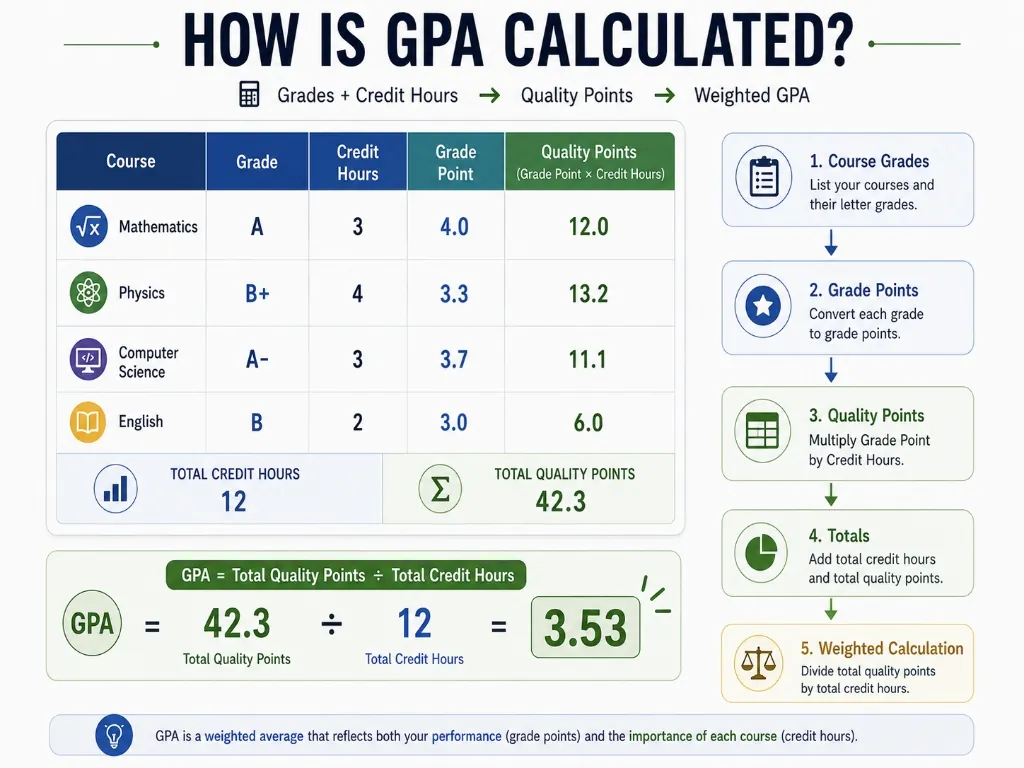
Worked Example: Single Semester GPA Calculation (4.0 Scale)
Suppose a student completes four courses in a semester:
| Subject | Letter Grade | Grade Point (4.0 Scale) | Credit Hours | Quality Points (Grade Point × Credits) |
|---|---|---|---|---|
| Mathematics | A | 4.0 | 3 | 4.0 × 3 = 12.0 |
| Physics | B+ | 3.3 | 4 | 3.3 × 4 = 13.2 |
| Computer Science | A- | 3.7 | 3 | 3.7 × 3 = 11.1 |
| English | B | 3.0 | 2 | 3.0 × 2 = 6.0 |
| Totals | - | - | 12 Credits | 42.3 Quality Points |
Calculation:
Semester GPA = 42.3 / 12 = 3.525 ≈ 3.53
The student earned a term GPA of 3.53 across 12 credit hours. You can verify this result instantly using a dedicated GPA calculator.
How Is CGPA Calculated?
To calculate cumulative CGPA across multiple semesters, universities combine the quality points and credit hours from every completed term into one overall ratio:
Cumulative CGPA = Total Quality Points Across All Semesters / Total Credit Hours Across All Semesters
Worked Example: Multi-Semester Cumulative CGPA
Continuing with the student above who earned 42.3 quality points across 12 credits in Semester 1 (GPA 3.53), suppose they complete Semester 2 with the following results:
- Advanced Calculus: 4 credits, Grade A (4.0) =
16.0quality points - Data Structures: 4 credits, Grade B+ (3.3) =
13.2quality points - Chemistry: 3 credits, Grade A- (3.7) =
11.1quality points - Ethics: 2 credits, Grade A (4.0) =
8.0quality points
Semester 2 Summary: 13 total credits, 16.0 + 13.2 + 11.1 + 8.0 = 48.3 quality points (Semester 2 SGPA: 48.3 / 13 = 3.72).
Cumulative Calculation (Combined Semesters 1 & 2):
- Total Quality Points =
42.3 (Sem 1) + 48.3 (Sem 2) = 90.6 - Total Degree Credits =
12 (Sem 1) + 13 (Sem 2) = 25 Cumulative CGPA = 90.6 / 25 = 3.624 ≈ 3.62
The student's cumulative CGPA after two semesters is 3.62. For a detailed breakdown of step-by-step calculations and multi-term scenarios, explore our guide on how to calculate CGPA.
Can You Calculate CGPA From Semester GPA?
A frequent question students ask is whether they can compute their cumulative CGPA directly from past semester GPA numbers without re-entering every individual course grade. Yes, you can—provided you know the total credit hours for each semester.
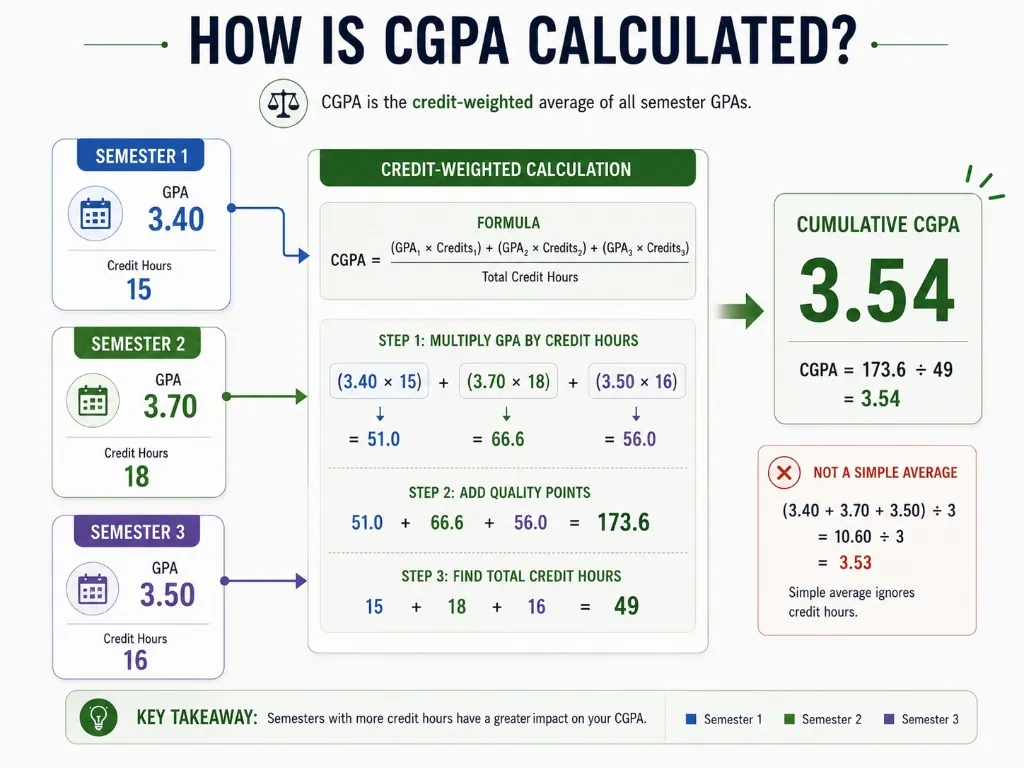
The mathematical relationship connecting semester GPAs to cumulative CGPA is:
Cumulative CGPA = Σ (Semester GPA × Semester Credit Hours) / Total Degree Credit Hours
Why Simply Averaging Semester GPAs Gives the Wrong Result
Many students make the mistake of taking a simple arithmetic mean of their semester GPAs. If your semesters have different credit loads, a simple average distorts your actual standing.
Consider a student with three semesters:
| Semester | Semester GPA (SGPA) | Credit Hours | Weighted Quality Points (GPA × Credits) |
|---|---|---|---|
| Semester 1 | 3.40 | 18 | 3.40 × 18 = 61.20 |
| Semester 2 | 3.70 | 21 | 3.70 × 21 = 77.70 |
| Semester 3 | 3.50 | 15 | 3.50 × 15 = 52.50 |
| Totals | - | 54 Total Credits | 191.40 Total Quality Points |
The Incorrect Simple Average:
Simple Average = (3.40 + 3.70 + 3.50) / 3 = 3.5333... ≈ 3.53
The Correct Credit-Weighted CGPA:
Cumulative CGPA = 191.40 / 54 = 3.5444... ≈ 3.54
The true weighted CGPA is 3.54 because the student performed best (3.70 GPA) during their heaviest academic load (21 credits). The simple average understated their performance by treating the 21-credit term identically to the 15-credit term. You can compute this weighted average effortlessly using the Semester GPA Mode in our online CGPA calculator.
Why Credit Hours Matter for Both GPA and CGPA
Credit hours represent the mathematical weighting assigned to each academic subject based on contact hours, lecture intensity, and laboratory requirements. Understanding credit weighting is essential for interpreting both term GPA and cumulative CGPA.
Course-Level Credit Weighting in GPA
When calculating a single semester's GPA, high-credit courses dominate the result:
- Course A (3 Credits, Grade A = 4.0): Contributes
3 × 4.0 = 12.0quality points - Course B (4 Credits, Grade B = 3.0): Contributes
4 × 3.0 = 12.0quality points - Course C (1 Credit, Grade C = 2.0): Contributes
1 × 2.0 = 2.0quality points
Total Credits = 8. Total Quality Points = 26.0. Weighted GPA = 26.0 / 8 = 3.25.
If you took a simple average of the grade points (4.0, 3.0, 2.0), the result would be 3.00. The actual GPA is 3.25 because Courses A and B together account for 87.5% of the total semester credit load.
Semester-Level Credit Weighting in CGPA
The same principle applies across multiple semesters. If Semester 1 carries 18 credits and Semester 2 carries 12 credits, Semester 1 carries 60% of the cumulative weight across those two terms. Earning higher marks in heavy-credit semesters provides a stronger buffer for your cumulative CGPA than performing well in lighter summer or winter sessions.
GPA vs CGPA on Different Grading Scales
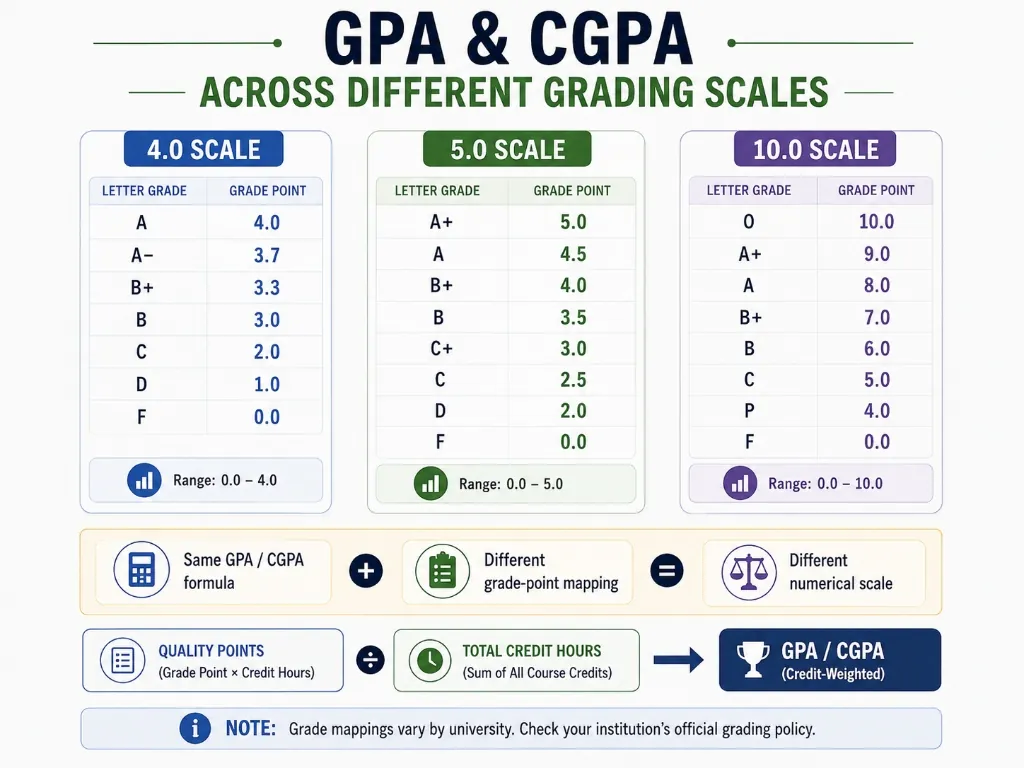
University grading scales vary significantly by country and academic institution. While the underlying weighted mathematics remains identical, the numerical range and grade point assignments differ.
| Grading Scale | Standard Numerical Range | Typical Geographic & Institutional Use | Representative Scale Mappings |
|---|---|---|---|
| 4.0 Scale (Standard) | 0.00 to 4.00 | United States, Canada, Saudi Arabia, International Universities | A = 4.0, A- = 3.7, B+ = 3.3, B = 3.0, C+ = 2.3, C = 2.0, D = 1.0, F = 0.0 |
| 5.0 Scale | 0.00 to 5.00 | Select European, West African, and Asian Universities | A+ = 5.0, A = 4.5, B+ = 4.0, B = 3.5, C+ = 3.0, C = 2.5, D = 2.0, F = 0.0 |
| 10.0 Scale (UGC / 10-Point) | 0.00 to 10.00 | India (UGC, AICTE, CBSE, Engineering & Medical Universities) | O = 10.0, A+ = 9.0, A = 8.0, B+ = 7.0, B = 6.0, C = 5.0, P = 4.0, F = 0.0 |
It is important to remember that grade point assignments are not universally identical across all universities. For instance, some institutions use a 4.33 scale where an A+ earns 4.33 points, while others cap all A grades at 4.00. Similarly, some universities assign 3.5 points for a B+ rather than 3.3. When calculating either GPA or CGPA, always confirm the specific grade point table published in your university's official handbook.
GPA vs CGPA for University Admissions, Scholarships, and Employment
Students often ask: Which is more important, GPA or CGPA? The answer depends on what you are applying for and who is evaluating your transcript.
1. Graduate School & University Admissions
For master's and doctoral program admissions, admissions committees prioritize CGPA as the baseline qualification metric. Most graduate programs establish hard CGPA minimum cutoffs (such as a 3.0 or 3.5 cumulative CGPA on a 4.0 scale). However, committees also inspect your semester-by-semester GPA trend. An upward GPA trajectory—where your term GPAs improve in junior and senior years as courses become more advanced—is viewed favorably, even if freshman-year grades lowered your overall CGPA.
2. Scholarship Selection & Renewals
Initial scholarship awards typically evaluate your cumulative CGPA from your high school or undergraduate transcript. However, ongoing scholarship retention policies often impose dual requirements: you may need to maintain a minimum cumulative CGPA (e.g., 3.20) while also maintaining a minimum term GPA (e.g., 3.00) every active semester to prevent funding suspension.
3. Employment & Internship Screening
When applying for entry-level jobs, internships, or corporate graduate schemes, employers generally ask for your cumulative CGPA on your resume. Recruiters use CGPA as an initial filter for high-volume applicant pools. Once you pass the screening stage, interviewers are more interested in your skills, portfolio, and relevant coursework performance than individual semester fluctuations.
4. Academic Standing & Honors
- Dean's List / Term Honors: Awarded based on your single-semester GPA (SGPA), recognizing outstanding achievement during that specific term (e.g., achieving a 3.75+ GPA with full-time enrollment).
- Graduation Honors (Latin Honors): Awarded based on your cumulative CGPA at graduation (e.g., Cum Laude for 3.50–3.69 CGPA, Magna Cum Laude for 3.70–3.89 CGPA, and Summa Cum Laude for 3.90+ CGPA).
- Academic Probation: Triggered when either your semester GPA or cumulative CGPA falls below the university's academic threshold (commonly 2.00 on a 4.0 scale).
GPA vs CGPA: Common Mistakes to Avoid
- Confusing GPA and CGPA on Official Applications: If an application asks for your CGPA, entering your last semester's GPA instead will misrepresent your record. Always report your cumulative figure unless a specific term GPA is requested.
- Calculating Simple Averages Across Semesters: As demonstrated earlier, averaging semester GPAs directly assumes equal credit loads. Always use credit-weighted mathematics.
- Assuming Higher GPA Automatically Means Higher CGPA: A student can earn a 3.90 GPA in Semester 3 while having a 3.40 cumulative CGPA due to lower grades in earlier semesters. Conversely, a student with a 3.70 CGPA might earn a 3.20 GPA in a particularly difficult semester.
- Mixing Grading Scales on Transcripts: If you transferred between institutions operating under different scales (e.g., from a 10.0 system to a 4.0 system), do not average raw numbers together without official credit evaluations from your registrar.
- Including Non-Credit or Audited Courses: Binary Pass/Fail, Satisfactory/No Credit, and audited courses should not be assigned quality points or included in the GPA denominator unless your institution's specific policy mandates it.
- Using Universal Percentage Formulas: CGPA does not convert to percentage using one worldwide equation. Different universities use different multipliers (such as multiplying by 9.5 in parts of India, multiplying by 10, or using published percentage ranges). Consult your university registrar for official conversion certificates.
When Should You Use a GPA Calculator vs. a CGPA Calculator?
Choosing the right calculation tool depends on whether you are assessing a single academic term or managing your entire degree progress:
- Use a GPA Calculator when:
- You are currently enrolled in a semester and want to calculate your expected term GPA from midterm or final exam scores.
- You want to test "what-if" scenarios for individual course letter grades before final grades are submitted.
- You need to determine whether your current semester performance qualifies you for the Dean's List or term honors.
- Use a CGPA Calculator when:
- You have completed multiple semesters and want to track your cumulative degree standing across all courses.
- You already know your past semester GPA figures and want to compute your cumulative CGPA using Semester GPA Mode without re-typing dozens of individual courses.
- You have course rosters stored in spreadsheets and want to use Excel / Google Sheets copy-paste to calculate cumulative standing instantly.
- You want to know what semester GPA you must achieve in remaining semesters to graduate with a specific target CGPA (e.g., hitting a 3.50 for graduation honors).
Frequently Asked Questions
Is GPA and CGPA the same?
No, GPA and CGPA are not the same. GPA (Grade Point Average) measures your academic performance for a single semester or specific term, while CGPA (Cumulative Grade Point Average) measures your combined academic performance across all completed semesters throughout your entire degree program.
What is the difference between GPA, SGPA, and CGPA?
GPA is a general term for grade point average. SGPA (Semester Grade Point Average) specifically measures performance in one semester. CGPA (Cumulative Grade Point Average) combines all semesters across your entire degree into a single credit-weighted average.
Is CGPA just the average of semester GPAs?
Only if every semester has the exact same number of credit hours. If semester credit loads vary (e.g., 18 credits in Fall and 12 credits in Spring), you cannot simply average your semester GPAs. You must multiply each semester GPA by its credit hours to calculate a credit-weighted cumulative CGPA.
Which is higher, GPA or CGPA?
Neither metric is inherently higher. In a strong semester, your term GPA will be higher than your cumulative CGPA. In a difficult semester, your term GPA will be lower than your cumulative CGPA. CGPA changes more slowly because it is buffered by all previously completed credit hours.
Can GPA be converted to CGPA?
Yes. If you have your semester GPAs and the total credit hours for each completed semester, you can calculate your cumulative CGPA using the weighted formula: Cumulative CGPA = Σ (Semester GPA × Semester Credits) / Total Credits.
Which is more important for jobs and graduate school, GPA or CGPA?
CGPA is generally more important for graduate school admissions and initial job applicant screenings because it demonstrates sustained academic consistency over several years. However, admissions committees also review semester GPA trends to see if your grades improved over time.
Do credit hours affect both GPA and CGPA?
Yes. In a single semester, courses with higher credit hours carry greater weight in your GPA. Across a full degree program, semesters with higher total credit loads contribute proportionally more to your cumulative CGPA.
Is a 3.5 GPA the same as a 3.5 CGPA?
Mathematically, both represent an average grade point of 3.50 (roughly between an A and B+ on a 4.0 scale). However, a 3.5 semester GPA represents one term of performance, whereas a 3.5 cumulative CGPA indicates that you have maintained a 3.5 average consistently across all completed coursework in your degree.
Can GPA or CGPA be converted to percentage?
There is no universal formula to convert GPA or CGPA to percentage. Different universities and educational boards establish their own conversion rules (e.g., multiplying by 9.5 or using bespoke conversion scales). Always check your university registrar's official policy for certified conversions.
Try the tools mentioned in this post - all free, no account needed.
Runs in your browser. No watermarks. No file uploads to a server.
Browse math calculators →