How to Convert CGPA to Percentage: Formula, Examples & University-Specific Methods
Learn how to convert CGPA to percentage using CBSE, AICTE, VTU, Mumbai University, and 4.0 scale formulas, conversion tables, and worked examples.
Whether you are filling out an online job application, registering for graduate admissions, applying for a government recruitment exam, or submitting documents for an international scholarship, you will often encounter a form that asks for your percentage of marks when your official academic transcript only reports a Cumulative Grade Point Average (CGPA).
A widespread assumption among students is that there is a single universal formula—most notably multiplying by 9.5—that works for every university in the world. This assumption is incorrect. While the 9.5 multiplier is widely recognized by certain educational boards (such as the CBSE and AICTE in India), universities across different regions, autonomous colleges, and international institutions use distinct conversion formulas, grade-band equivalence tables, or formal conversion certificates.
This guide explains how to convert CGPA to percentage accurately. You will learn the mathematics behind the most common conversion rules, explore university-specific formulas with verifiable scheme details, understand why CGPA percentage differs from raw marks percentage, and find out what to submit when an official application demands proof of equivalence.
How to Convert CGPA to Percentage
To convert your CGPA to percentage, you apply the official conversion formula established by your academic board or university. If your institution follows the standard 10-point scale popularized by the Central Board of Secondary Education (CBSE) or the All India Council for Technical Education (AICTE), the general formula is:
Percentage (%) = CGPA × 9.5
Applicable under CBSE, AICTE, and institutions adopting standard 10-point scale guidelines.
For example, if you earned an 8.4 CGPA under this convention, your percentage equivalent is:
Percentage = 8.4 × 9.5 = 79.8%
(CGPA - 0.75) × 10 or a direct CGPA × 10), the official institutional formula always takes precedence over generic formulas.
Is There a Universal CGPA to Percentage Formula?
No, there is no universal CGPA-to-percentage formula. The mathematical relationship between grade points and percentage scores depends on several institutional design choices:
- Different Maximum Scales: Universities grade students on 4.0 scales (common in the United States and Canada), 5.0 scales (used in select European and African universities), and 10.0 scales (common across India and South Asia). A single linear equation cannot equate a 3.8 on a 4.0 scale with a 3.8 on a 10.0 scale.
- Relative vs. Absolute Grading: In an absolute grading system, fixed mark brackets determine your grade (e.g., 80–100% = Grade A = 10 points). In a relative grading (curved) system, grades depend on the cohort's statistical distribution, meaning two students with the same raw score in different terms might receive different grade points.
- Varying Cutoff Baselines: Some engineering universities define passing at 40% (4.0 grade points), while others set passing at 50% (5.0 grade points). Because the minimum threshold differs, the slope of the conversion line must adjust accordingly.
- Scheme and Regulation Changes: A single university often updates its grading ordinances across different batch years. For instance, an older academic scheme may have used a lookup table, while a newer Choice Based Credit System (CBCS) regulation introduced an algebraic formula.
Whenever you need an accurate academic conversion, treat generic online formulas as estimates unless verified against your university's official examination regulations.
The Most Common CGPA to Percentage Formulas
Higher education institutions generally employ one of several established conversion conventions:
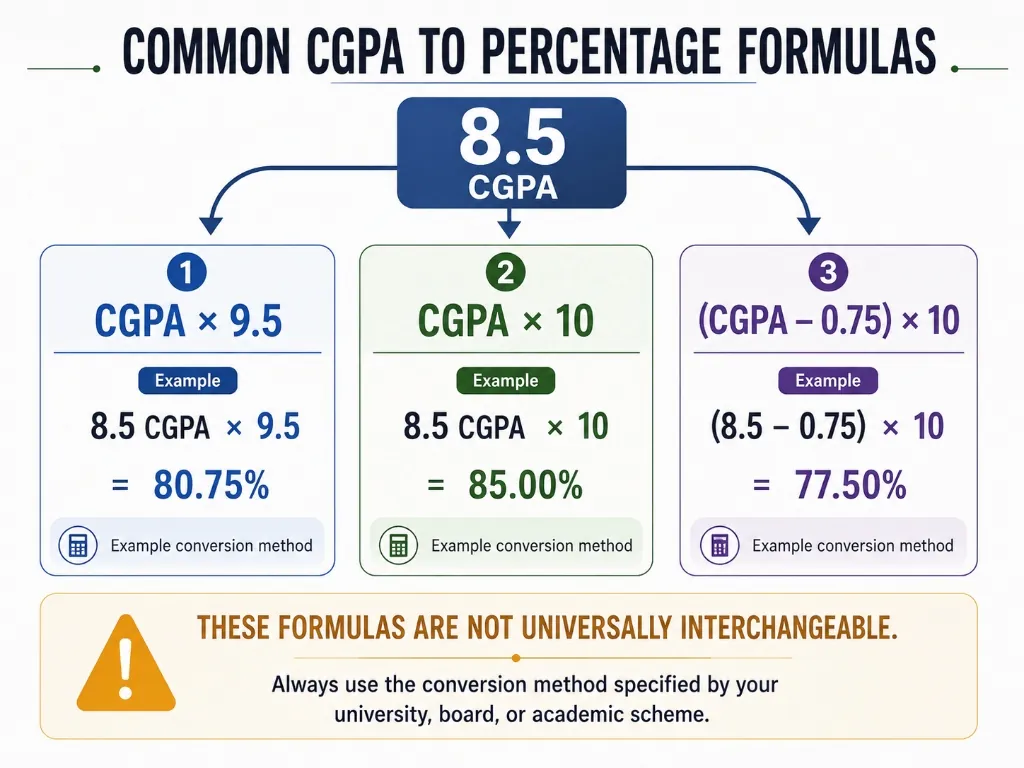
1. CGPA × 9.5 (CBSE / AICTE Standard)
This is the most widely recognized formula across India. The 9.5 multiplier was derived by analyzing historical examination data over multi-year candidate cohorts. Statisticians calculated the average percentage of marks scored by students in the top grade bands, finding that candidates who secured a 10.0 CGPA achieved an average of approximately 95% rather than 100%. Multiplying by 9.5 yields a realistic reflection of cumulative performance on a 10-point scale.
2. CGPA × 10 (Direct 10-Point Linear Scaling)
Select autonomous universities, international technical institutes, and private colleges use a direct multiplier of 10. Under this system, each full grade point represents exactly 10 percentage points (e.g., a 7.0 CGPA equals 70.0%, and a 9.2 CGPA equals 92.0%). While mathematically straightforward, this formula should only be used if explicitly confirmed by your university registrar.
3. (CGPA - 0.75) × 10 (VTU Formula)
Visvesvaraya Technological University (VTU), which affiliates hundreds of engineering colleges in Karnataka, officially adopted this formula for its Choice Based Credit System (CBCS) regulations (specifically documented for its 2015, 2017, and 2018 schemes). This equation accounts for VTU's specific passing criteria and credit-weighting structure. Under this rule, an 8.0 CGPA yields (8.0 - 0.75) × 10 = 72.5%.
4. Faculty-Specific Formulas: Mumbai University Engineering
The University of Mumbai implements piecewise linear conversion formulas depending on whether a student's CGPA is above or below 7.0 on a 10-point scale:
- For CGPA < 7.0:
Percentage = (7.1 × CGPA) + 12 - For CGPA ≥ 7.0:
Percentage = (7.4 × CGPA) + 12
Under this official guideline, a student with a 6.5 CGPA earns (7.1 × 6.5) + 12 = 58.15%, whereas a student with an 8.0 CGPA earns (7.4 × 8.0) + 12 = 71.2%.
5. (CGPA - 0.5) × 10 (Autonomous Technical Institute Formula)
Certain autonomous institutes (such as select National Institutes of Technology or state technical universities) deduct 0.5 grade points before multiplying by 10. Under this convention, an 8.0 CGPA converts to (8.0 - 0.5) × 10 = 75.0%.
6. Grade-Band Lookup & Equivalence Tables
Rather than using an algebraic multiplier, some universities publish discrete equivalence tables in their academic handbooks. For example, a CGPA between 7.50 and 7.99 may be formally classified as "First Class (65%–69.9%)", while 8.00+ is designated as "First Class with Distinction (70%+)". In these systems, official transcripts typically carry a narrative class award rather than an exact converted percentage.
University & Board Conversion Formulas: Authoritative Comparison Table
The table below summarizes official conversion policies documented by major educational boards and universities:
| Institution / Board | Grading Scale | Official Conversion Formula / Rule | Applicability / Scheme Notes | Result for 8.0 CGPA |
|---|---|---|---|---|
| CBSE (Class 10 / 12) | 10.0 Scale | Percentage = CGPA × 9.5 |
Standard nationwide CBSE guideline | 8.0 × 9.5 = 76.0% |
| AICTE (Technical Colleges) | 10.0 Scale | Percentage = (CGPA - 0.75) × 10 or CGPA × 9.5 |
AICTE model guidelines; verify institution handbook | 72.5% or 76.0% |
| VTU (Visvesvaraya Tech. Univ.) | 10.0 Scale | Percentage = (CGPA - 0.75) × 10 |
Officially documented for 2015, 2017, and 2018 CBCS schemes | (8.0 - 0.75) × 10 = 72.5% |
| University of Mumbai | 10.0 Scale | (7.4 × CGPA) + 12 (if ≥ 7.0)(7.1 × CGPA) + 12 (if < 7.0) |
Engineering faculty regulations; check official circulars | (7.4 × 8.0) + 12 = 71.2% |
| Anna University | 10.0 Scale | Percentage = CGPA × 10 |
Standard CBCS regulation for engineering faculties | 8.0 × 10 = 80.0% |
| MAKAUT (WBUT) | 10.0 Scale | Percentage = (CGPA - 0.75) × 10 |
Technical degree programmes under CBCS framework | (8.0 - 0.75) × 10 = 72.5% |
| HEC Pakistan | 4.0 Scale | (CGPA / 4.0) × 100 or Equivalence Tables |
National Higher Education Commission equivalence guidelines | N/A (4.0 scale system) |
Note: Institutional regulations are subject to revision. Always verify the current formula printed on the reverse side of your official marksheet or certified by your controller of examinations.
Worked CGPA to Percentage Examples
To see how different institutional formulas impact your final percentage, compare calculations for standard academic milestones:
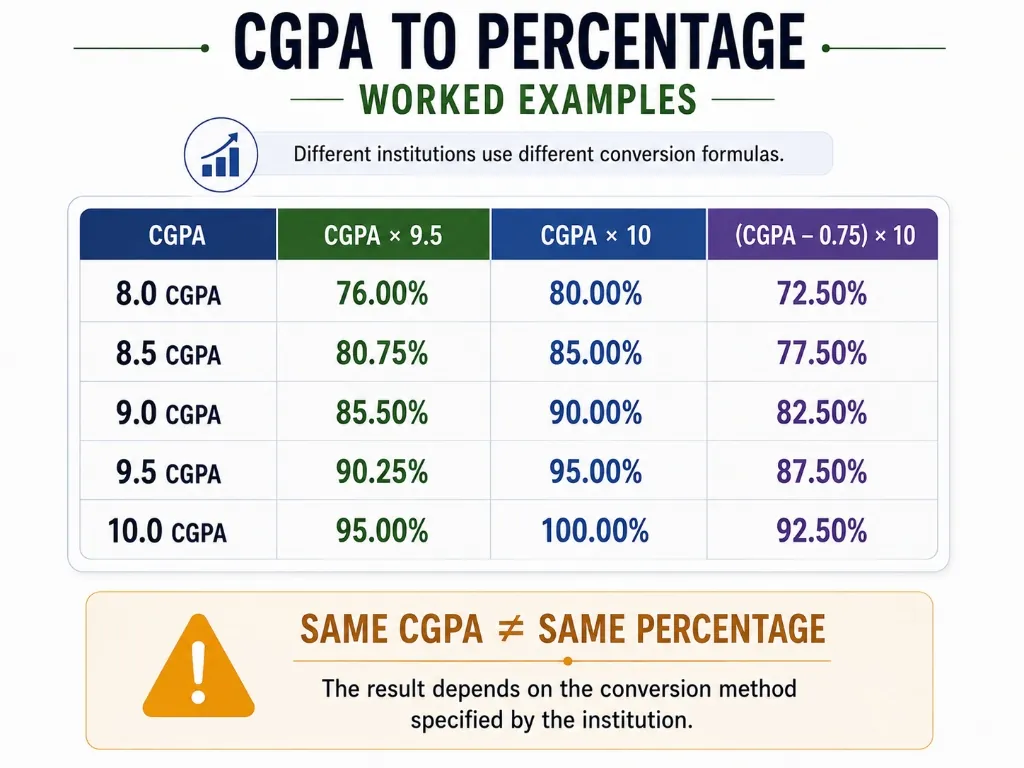
Example 1: Converting 8.0 CGPA
- Under ×9.5 Formula:
8.0 × 9.5 = 76.0% - Under ×10 Formula:
8.0 × 10 = 80.0% - Under VTU Formula
(CGPA - 0.75) × 10:(8.0 - 0.75) × 10 = 72.5% - Under Mumbai University Formula
(7.4 × CGPA) + 12:(7.4 × 8.0) + 12 = 71.2%
Example 2: Converting 8.5 CGPA
- Under ×9.5 Formula:
8.5 × 9.5 = 80.75% - Under ×10 Formula:
8.5 × 10 = 85.0% - Under VTU Formula:
(8.5 - 0.75) × 10 = 77.5% - Under Mumbai University Formula:
(7.4 × 8.5) + 12 = 74.9%
Example 3: Converting 9.0 CGPA
- Under ×9.5 Formula:
9.0 × 9.5 = 85.5% - Under ×10 Formula:
9.0 × 10 = 90.0% - Under VTU Formula:
(9.0 - 0.75) × 10 = 82.5% - Under Mumbai University Formula:
(7.4 × 9.0) + 12 = 78.6%
Example 4: Converting 9.5 CGPA
- Under ×9.5 Formula:
9.5 × 9.5 = 90.25% - Under ×10 Formula:
9.5 × 10 = 95.0% - Under VTU Formula:
(9.5 - 0.75) × 10 = 87.5% - Under Mumbai University Formula:
(7.4 × 9.5) + 12 = 82.3%
Example 5: Converting 10.0 CGPA
- Under ×9.5 Formula:
10.0 × 9.5 = 95.0% - Under ×10 Formula:
10.0 × 10 = 100.0% - Under VTU Formula:
(10.0 - 0.75) × 10 = 92.5% - Under Mumbai University Formula:
(7.4 × 10.0) + 12 = 86.0%
As these examples demonstrate, an 8.5 CGPA can translate to anywhere between 74.9% and 85.0% depending on the institution. Using the wrong formula on a formal application can significantly misrepresent your credentials.
Comprehensive CGPA to Percentage Reference Table
The following table provides side-by-side conversions across the three most common 10-point scale mathematical methods:
| CGPA (10.0 Scale) | Standard ×9.5 Formula (%) | Direct ×10 Formula (%) | VTU Formula (CGPA - 0.75) × 10 (%) |
|---|---|---|---|
| 6.0 | 57.00% | 60.00% | 52.50% |
| 6.2 | 58.90% | 62.00% | 54.50% |
| 6.4 | 60.80% | 64.00% | 56.50% |
| 6.6 | 62.70% | 66.00% | 58.50% |
| 6.8 | 64.60% | 68.00% | 60.50% |
| 7.0 | 66.50% | 70.00% | 62.50% |
| 7.2 | 68.40% | 72.00% | 64.50% |
| 7.4 | 70.30% | 74.00% | 66.50% |
| 7.6 | 72.20% | 76.00% | 68.50% |
| 7.8 | 74.10% | 78.00% | 70.50% |
| 8.0 | 76.00% | 80.00% | 72.50% |
| 8.2 | 77.90% | 82.00% | 74.50% |
| 8.4 | 79.80% | 84.00% | 76.50% |
| 8.6 | 81.70% | 86.00% | 78.50% |
| 8.8 | 83.60% | 88.00% | 80.50% |
| 9.0 | 85.50% | 90.00% | 82.50% |
| 9.2 | 87.40% | 92.00% | 84.50% |
| 9.4 | 89.30% | 94.00% | 86.50% |
| 9.6 | 91.20% | 96.00% | 88.50% |
| 9.8 | 93.10% | 98.00% | 90.50% |
| 10.0 | 95.00% | 100.00% | 92.50% |
CGPA Percentage vs. Actual Marks Percentage
One of the most critical concepts students overlook is that a percentage converted from CGPA is rarely identical to the percentage calculated from your raw exam marks.
To understand why this happens, consider how grading systems work:
- Actual Marks Percentage: Computed directly from your total raw scores across all subjects:
(Total Marks Obtained / Maximum Possible Marks) × 100. - CGPA-Derived Percentage: Computed by first converting raw scores into discrete letter grade points (e.g., any score between 80 and 89 receives 9 grade points), weighting those points by credit hours, and finally applying a linear conversion multiplier.
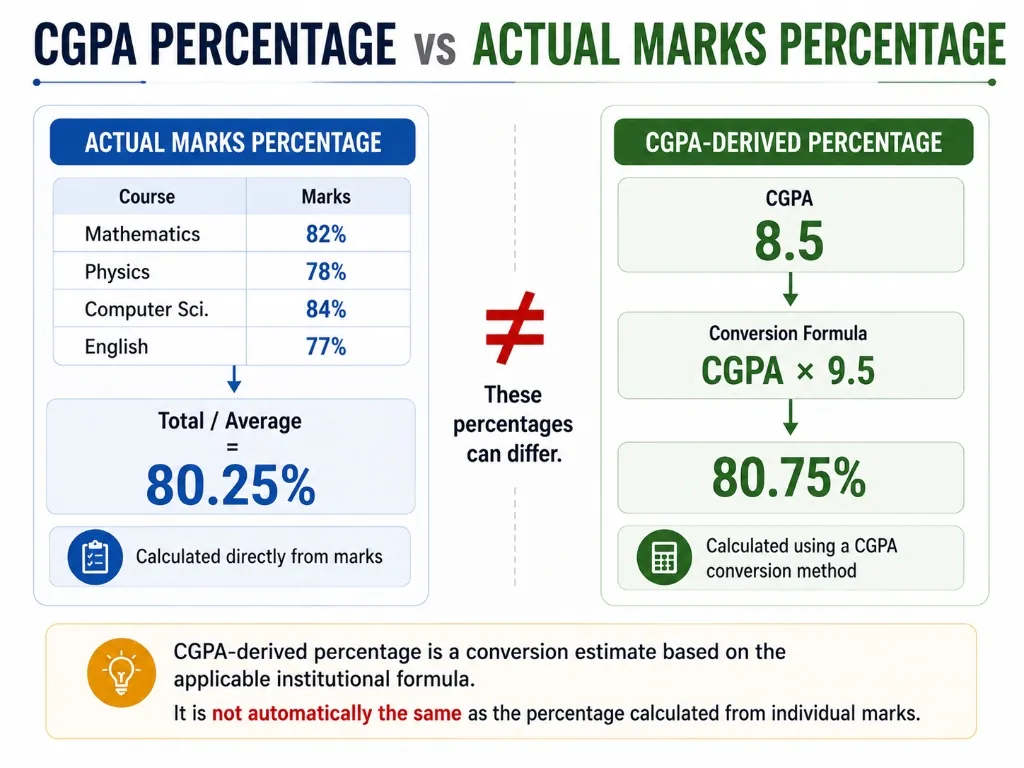
A Concrete Demonstration
Suppose a student completes 4 courses (100 marks each, 400 total marks):
| Course Name | Raw Score (out of 100) | Credit Hours | Grade Point Awarded | Quality Points (Grade Point × Credits) |
|---|---|---|---|---|
| Mathematics | 89 | 3 | 9.0 (Grade A: 80–89 marks) | 9.0 × 3 = 27.0 |
| Physics | 81 | 3 | 9.0 (Grade A: 80–89 marks) | 9.0 × 3 = 27.0 |
| Computer Science | 79 | 4 | 8.0 (Grade B+: 70–79 marks) | 8.0 × 4 = 32.0 |
| English | 72 | 2 | 8.0 (Grade B+: 70–79 marks) | 8.0 × 2 = 16.0 |
| Total | 321 / 400 Marks | 12 Credits | - | 102.0 Quality Points |
Comparing the two calculations:
- Actual Raw Marks Percentage:
(321 / 400) × 100 = 80.25% - CGPA:
102.0 Quality Points / 12 Total Credits = 8.50 CGPA - CGPA Percentage (×9.5 Formula):
8.50 × 9.5 = 80.75% - CGPA Percentage (×10 Formula):
8.50 × 10 = 85.00%
The student's raw marks percentage is 80.25%, while their CGPA converted percentage is 80.75% (or 85.00%). This divergence occurs because score banding compresses individual marks into uniform grade points. To calculate raw percentage ratios directly from marks, you can use a dedicated percentage calculator.
Can You Convert a 4.0 CGPA to Percentage?
Students from North American universities or international institutions operating on a 4.0 GPA scale frequently ask how to convert a 4.0 CGPA into a percentage score.
In standard US and Canadian higher education, percentage conversions are generally not used or officially recognized. Transcripts report letter grades and GPA on a 4.0 scale, and graduate admissions committees evaluate candidates based on GPA cutoffs (such as a 3.0 or 3.5 minimum GPA) rather than percentage equivalents.
While multiplying by 25 (Percentage = CGPA × 25) is mathematically intuitive, it is an oversimplified linear approximation that fails to represent true academic difficulty. Under a 4.0 scale, a 3.0 GPA represents a "B" grade average (roughly 80–83%), but multiplying 3.0 by 25 yields only 75%.
For international evaluations (such as credential evaluations by WES or ECE):
- Evaluators assess your original course grades against accredited regional grading scales rather than converting GPA to percentage.
- In Pakistan, the Higher Education Commission (HEC) provides official equivalence tables that map 4.0 scale CGPA bands to specific percentage and division tiers for civil service and higher study eligibility.
To understand the difference between term GPA and cumulative standing before calculating conversions, review our detailed guide on GPA vs CGPA.
How to Find Your University's Official Conversion Formula
To obtain an officially accepted percentage conversion for job applications or graduate admissions, follow these steps:
- Inspect the Reverse Side of Your Marksheet: Most universities print their official grading regulations, grade-point mappings, and percentage conversion formulas directly on the back of the grade card or transcript.
- Review the Academic Ordinance / Handbook: Visit your university's official website and download the academic regulations or CBCS ordinance corresponding to your degree program and enrollment year.
- Search the Controller of Examinations (COE) Portal: Universities frequently issue official circulars titled "Notification regarding conversion of CGPA to Percentage".
- Request a Conversion Certificate: If an application portal explicitly requires certified percentage proof, submit a formal request to your university's registrar or examination branch for an official CGPA to Percentage Conversion Certificate printed on university letterhead with registrar seal and signature.
- Do Not Invent a Formula: If your university explicitly does not provide a conversion formula, state that your institution follows a CGPA-only system rather than guessing a multiplier.
CGPA to Percentage for Job Applications & Competitive Exams
Job recruitment portals (such as corporate HR systems, IT service companies, and government recruiting boards like UPSC, SSC, or state public service commissions) often enforce strict percentage eligibility criteria (e.g., "Minimum 60% in graduation").
How to Handle Application Forms:
- If the Portal Allows CGPA: Always enter your raw CGPA exactly as printed on your degree transcript. Do not convert if the form provides a designated CGPA field.
- If Percentage Is Mandatory: Convert your CGPA using only your institution's official formula.
- Supporting Documentation: Keep a scanned copy of your university's conversion circular or conversion certificate ready to upload alongside your transcript.
CGPA to Percentage for University Admissions & Scholarships
When applying for master's programs, doctoral fellowships, or international study visas:
- Admissions Cutoffs: Universities often establish minimum eligibility tiers (such as "First Class with 65% aggregate or 7.0 CGPA"). If both options are stated, you may qualify under either metric.
- Study Abroad Applications: Most international admissions offices (in the US, UK, Germany, and Australia) prefer to receive your original CGPA transcript directly. They use standardized credential evaluators to assess course grades rather than requiring manual percentage conversions.
- Scholarship Eligibility: Highly competitive scholarships (such as Fulbright, Commonwealth, or DAAD) evaluate cumulative academic consistency. To calculate your multi-semester cumulative grade points accurately before converting, use our online CGPA calculator or consult our complete walkthrough on how to calculate CGPA.
How to Convert Percentage to CGPA (The Reverse Calculation)
If you have a percentage and need to estimate your CGPA equivalent, you invert the specific formula used by your institution:
- Under ×9.5 Formula:
CGPA = Percentage / 9.5(e.g.,76% / 9.5 = 8.00 CGPA) - Under ×10 Formula:
CGPA = Percentage / 10(e.g.,85% / 10 = 8.50 CGPA) - Under VTU Formula:
CGPA = (Percentage / 10) + 0.75(e.g.,(72.5 / 10) + 0.75 = 8.00 CGPA)
Note: Reverse calculation is only mathematically valid when applied to the same conversion convention. It cannot recreate original course-level credit weights or grade points.
Common CGPA to Percentage Mistakes to Avoid
- Blindly Multiplying by 9.5 for Every University: Applying CBSE/AICTE rules to institutions with distinct formulas (like VTU or Mumbai University) produces incorrect results.
- Confusing Raw Marks Percentage with CGPA Percentage: Grade-point compression means converted percentage rarely matches raw exam score totals.
- Ignoring Scheme and Batch Year Regulations: Ensure the conversion formula you cite matches your enrollment year rather than outdated or newly amended regulations.
- Using Linear Multipliers on 4.0 Scale Transcripts: Multiplying a 4.0 GPA by 25 is an informal estimate that is not accepted by formal admissions bodies.
- Premature Rounding: Always perform calculations to two decimal places before rounding your final percentage.
Frequently Asked Questions
How do I convert CGPA to percentage?
To convert CGPA to percentage, multiply your CGPA by your institution's official conversion factor. For universities following standard 10-point scale guidelines (such as CBSE or AICTE), the formula is Percentage = CGPA × 9.5. If your university uses a specific formula (such as VTU's (CGPA - 0.75) × 10), use your university's official equation.
What is the formula for converting CGPA to percentage?
The standard formula on a 10-point scale is Percentage (%) = CGPA × 9.5. However, specific universities use alternative formulas such as Percentage = CGPA × 10 or Percentage = (CGPA - 0.75) × 10. Always verify the formula on the back of your official marksheet.
Is CGPA × 9.5 always correct?
No. While CGPA × 9.5 is standard for CBSE and AICTE-affiliated institutions, it is not universal. Autonomous universities, state technological boards, and international institutions often prescribe their own specific conversion formulas or lookup tables.
Is CGPA × 10 correct?
Only if your specific university has officially mandated a direct 10-point conversion policy. While common in select autonomous colleges, it should not be assumed as the default for all 10-point scale transcripts.
How much is 8.0 CGPA in percentage?
Under the standard × 9.5 formula, an 8.0 CGPA equals 76.0% (8.0 × 9.5). Under a direct × 10 formula, it equals 80.0%. Under VTU's formula, it equals 72.5% ((8.0 - 0.75) × 10).
How much is 8.5 CGPA in percentage?
Under the standard × 9.5 formula, an 8.5 CGPA equals 80.75% (8.5 × 9.5). Under a direct × 10 formula, it equals 85.0%. Under VTU's formula, it equals 77.5%.
How much is 9.0 CGPA in percentage?
Under the standard × 9.5 formula, a 9.0 CGPA equals 85.5% (9.0 × 9.5). Under a direct × 10 formula, it equals 90.0%. Under VTU's formula, it equals 82.5%.
How much is 10.0 CGPA in percentage?
Under the standard × 9.5 formula, a 10.0 CGPA equals 95.0% (10.0 × 9.5). Under a direct × 10 formula, it equals 100.0%. Under VTU's formula, it equals 92.5%.
Can I convert a 4.0 CGPA to percentage?
4.0 GPA systems do not officially convert to percentage using a universal formula. While CGPA × 25 is a simple mathematical ratio, international institutions and evaluators evaluate 4.0 GPA transcripts using letter-grade cutoffs or credential evaluation tables rather than raw percentages.
Why does CGPA percentage differ from actual marks percentage?
Grade points are assigned in discrete score brackets (e.g., 80–89% = Grade A = 9 points). Because all scores within that bracket receive the same grade points, converting CGPA back into percentage compresses individual variations, causing the converted result to differ from your raw mark total.
Which percentage should I enter on a job application?
If the application does not accept CGPA directly, use your university's official conversion formula and keep a copy of your university's conversion certificate or official marksheet guideline ready to verify your calculation.
Try the tools mentioned in this post - all free, no account needed.
Runs in your browser. No watermarks. No file uploads to a server.
Browse math calculators →