How to Calculate Zakat: Nisab, Eligible Wealth, Deductions, and Common Mistakes
Learn how to calculate Zakat accurately with step-by-step formulas, gold and silver Nisab thresholds, asset eligibility rules, deductible debts, and common pitfalls.
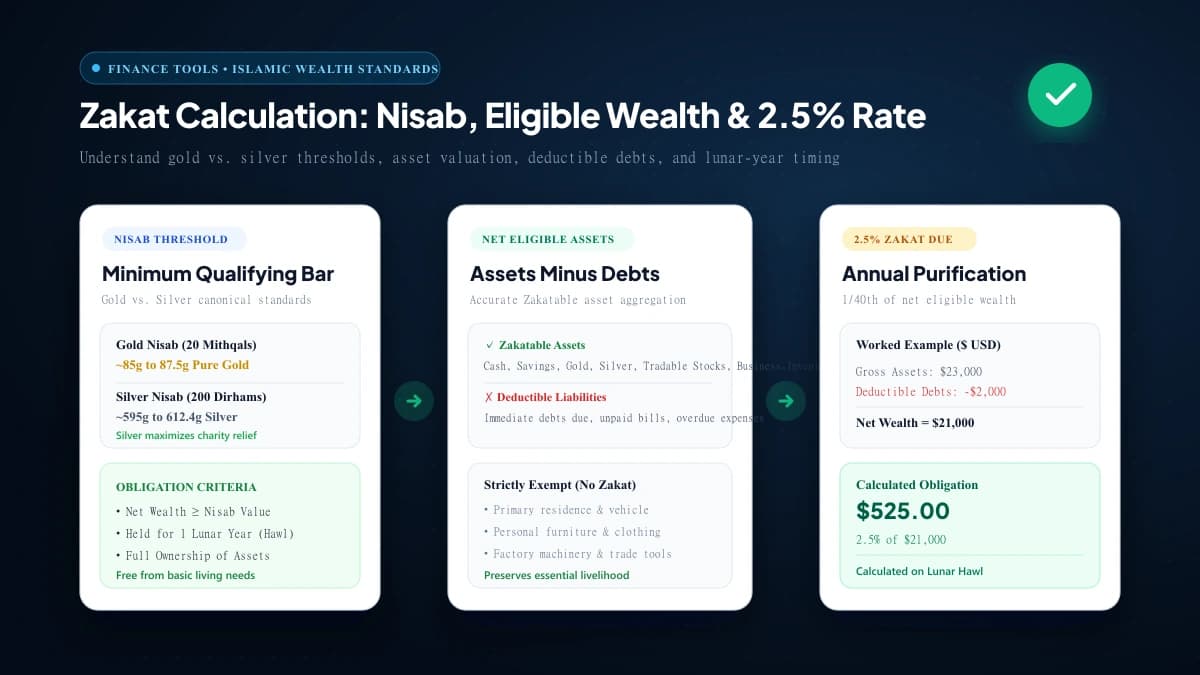
Zakat is the third pillar of Islam—an obligatory annual act of worship and wealth redistribution designed to purify surplus assets and alleviate poverty across society. Every mentally sound adult Muslim who possesses wealth equal to or exceeding a qualifying baseline known as the Nisab for one full lunar year (Hawl) is religiously obligated to pay 2.5% (one fortieth, or 1/40) of their net Zakatable surplus wealth to designated recipients.
While the mathematical rate of 2.5% is straightforward, calculating Zakat in contemporary financial life can feel complex. Modern portfolios span liquid bank accounts, physical gold jewelry of varying karats, tradable stocks, mutual funds, retirement accounts, business inventory, and multi-year liabilities like home mortgages. Determining which assets count, which debts are deductible, and whether to benchmark against the gold or silver Nisab requires clear, authoritative rules.
This comprehensive guide explains how to calculate Zakat step by step, how Nisab thresholds function, which assets are Zakatable versus exempt, how debts are treated under contemporary scholarly consensus, and how to use our free, multi-currency CoditTools Zakat Calculator.
Disclaimer on Individual Religious Guidance:
This guide outlines established Islamic jurisprudence (fiqh) and contemporary standards adopted by major bodies such as the Accounting and Auditing Organization for Islamic Financial Institutions (AAOIFI) and the OIC Islamic Fiqh Academy. Because personal financial circumstances and regional scholarly interpretations vary, consult a qualified Islamic scholar or local religious authority for bespoke rulings regarding complex trust structures or contested assets.
What Is Zakat and Who Must Pay It?
Linguistically, the Arabic word Zakat denotes purification, growth, and blessing. Spiritually, it purifies the giver's heart from greed and commercial selfishness, while economically circulating wealth from surplus capital into the hands of vulnerable community members. In the Quran, the obligation of Zakat is frequently paired directly with prayer (Salah), underscoring its foundational importance.
Zakat becomes an individual obligation (Fard al-Ayn) when a person meets four foundational criteria:
- Muslim Identity: Zakat is an Islamic act of worship binding upon Muslims.
- Full and Absolute Ownership (Milk al-Tamm): You must have complete legal and physical ownership and control over the asset. Funds that are irrevocably lost, confiscated, or currently inaccessible are not Zakatable until recovered.
- Wealth Above Nisab: Your net surplus assets (after deducting immediate living expenses and short-term liabilities) must equal or exceed the minimum monetary threshold (Nisab).
- Completion of One Lunar Year (Hawl): That qualifying surplus must be maintained for one continuous Islamic lunar year (~354 days).
What Is Nisab? Gold vs. Silver Standards Explained
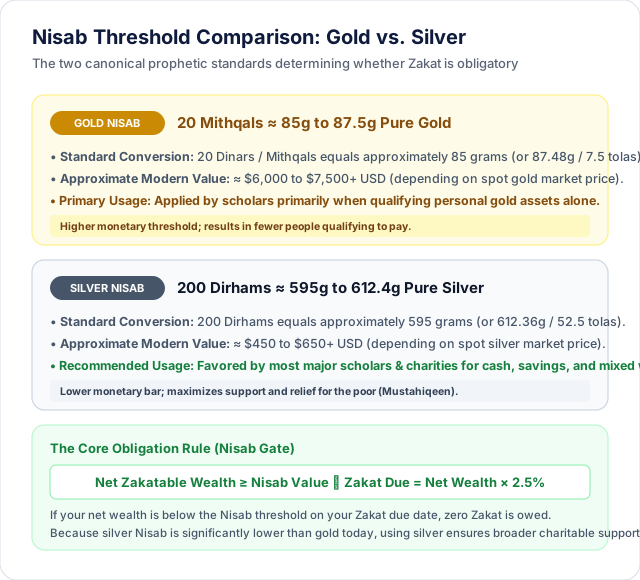
The Nisab is the minimum quantity of net wealth a Muslim must own before Zakat becomes obligatory. If your net wealth is below Nisab, you owe nothing; in fact, you may be eligible to receive Zakat. If your net wealth equals or exceeds Nisab on your annual Zakat date, 2.5% of your total net surplus is due.
The Two Prophetic Standards
Prophet Muhammad (peace be upon him) established two distinct metal benchmarks for Nisab based on the common currency of the 7th-century Arabian Peninsula:
-
Gold Nisab (20 Mithqals / Dinars):
Classical scholars across the four Sunni madhabs (Hanafi, Maliki, Shafi'i, and Hanbali) agree that 20 Mithqals corresponds to approximately 85 grams of pure 24-karat gold (some South Asian traditional manuals cite 87.48 grams, or 7.5 tolas). At modern spot gold prices (approx. $70 to $80 per gram), the Gold Nisab fluctuates between $6,000 and $7,000+ USD.
-
Silver Nisab (200 Dirhams):
Classical consensus establishes 200 Dirhams as approximately 595 grams of pure silver (traditionally cited as 612.36 grams, or 52.5 tolas). At modern spot silver prices (approx. $0.90 to $1.10 per gram), the Silver Nisab equates to roughly $500 to $650+ USD.
Why Gold and Silver Values Diverged
In classical times, 85 grams of gold and 595 grams of silver possessed roughly equal purchasing power—the historical bimetallic gold-to-silver exchange ratio sat between 1:7 and 1:10. However, over the past century, industrial silver production and financial market dynamics pushed the gold-to-silver ratio to roughly 1:80 or 1:90.
Today, the Gold Nisab represents a substantially higher wealth hurdle than the Silver Nisab.
Which Nisab Should You Use?
Contemporary scholars and major global Zakat organizations (including Islamic Relief Worldwide, the National Zakat Foundation, and the OIC International Islamic Fiqh Academy) offer clear guidelines on selecting between the two standards:
| Asset Profile | Recommended Standard | Scholarly Rationale |
|---|---|---|
| Cash, Bank Savings & Mixed Investments | Silver Nisab (~595g) | Adopts the lower monetary threshold (Anfa' lil-Fuqara—"most beneficial to the poor"). It allows more individuals with modest savings to contribute to social welfare. |
| Exclusively Gold Assets | Gold Nisab (~85g) | If a person owns solely gold bullion or jewelry and possesses no surplus cash or other investments, scholars universally evaluate eligibility against the gold standard directly. |
| Exclusively Silver Assets | Silver Nisab (~595g) | Evaluated strictly against the silver weight. |
The Lunar Year Requirement (Hawl): How Time Affects Zakat
Zakat is not a tax on income earned; it is a levy on accumulated, unspent wealth that has remained in your possession for one full lunar year (Hawl). A lunar year is approximately 354 days long—about 11 days shorter than a standard solar (Gregorian) calendar year.
Establishing Your Zakat Anniversary Date
- The Starting Milestone: The day your net surplus wealth first hits or crosses the Nisab threshold marks the start of your personal Hawl.
- The Annual Checkpoint: Exactly one Islamic lunar year later (for example, the 1st of Ramadan or the 15th of Muharram), you take a snapshot of all your Zakatable assets. If your net wealth remains at or above Nisab on that date, you pay 2.5% on the entire balance present that day.
- Fluctuations During the Year: Under the majority Hanafi position, you do not need to track every individual dollar for 354 days. As long as your wealth met Nisab at the start of your Hawl, did not drop to zero mid-year, and meets Nisab on your annual checkpoint, Zakat is due on the full balance on your anniversary—including salary, gifts, or investment returns deposited just weeks or days before.
Lunar vs. Solar (Gregorian) Calculation Rates
Because the Islamic calendar is strictly lunar, the classical Zakat rate is 2.5% (1/40th) per lunar year. If an individual, corporation, or charitable endowment calculates Zakat using the standard 365-day Gregorian solar calendar for accounting convenience, the rate must be mathematically adjusted to account for the additional 11 days:
Our online Zakat calculator applies the canonical 2.5% lunar rate, which is standard for individual households.
Comprehensive Breakdown of Zakatable Assets
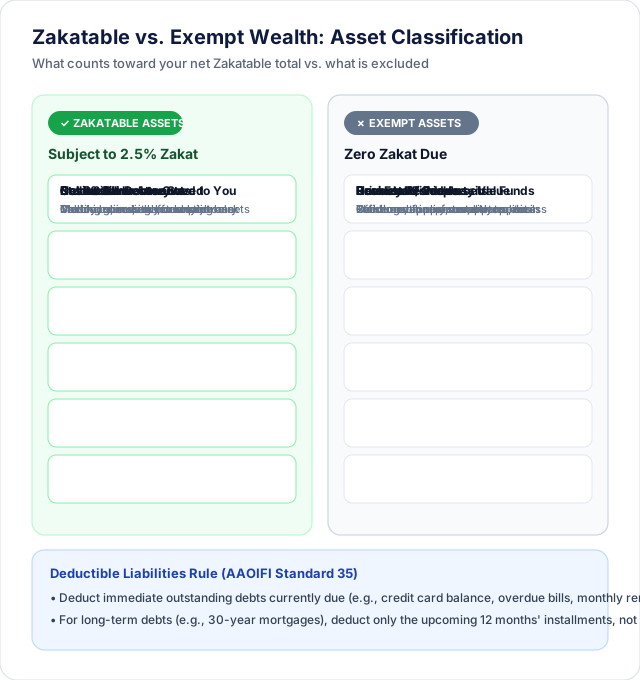
To calculate your Zakat accurately, you must inventory all assets that possess growth potential (al-Amwal al-Namiyah). The primary categories include:
1. Cash and Liquid Bank Balances
Every dollar, euro, pound, or riyal you possess across checking accounts, high-yield savings accounts, foreign currency reserves, digital payment wallets (PayPal, Venmo), and physical cash hidden at home is 100% Zakatable at face value.
2. Physical Gold and Silver
Gold and silver are monetary metals by definition. Bullion, bars, coins, and commemorative medals are always Zakatable. However, regarding personal gold jewelry worn by women, classical jurisprudence contains a well-known difference of opinion:
- The Hanafi School: Holds that all gold and silver is Zakatable, regardless of whether it is worn as daily personal jewelry or stored as investment.
- The Shafi'i, Maliki, and Hanbali Schools: Hold that customary, non-extravagant personal jewelry worn regularly is treated as personal apparel and is exempt from Zakat. However, jewelry bought with investment intent or stored in vaults for wealth preservation remains Zakatable.
3. Stocks, Mutual Funds, and ETFs
How you treat equity investments depends on your investment strategy:
- Active Trading / Short-Term Speculation: If you buy stocks with the primary intention of reselling them for capital gains within a short horizon, the shares are treated like trade merchandise. Zakat is due on the full market value of the portfolio on your Zakat date.
- Long-Term Buy-and-Hold (Dividend Investing): If you hold shares for long-term dividends, you do not pay Zakat on the entire market capitalization (which includes non-Zakatable fixed assets like buildings and patents). Instead, you pay 2.5% on the company's underlying net Zakatable assets per share (cash + inventory + trade receivables minus short-term debts). If extracting balance sheet data is impractical, major scholarly bodies (including the AAOIFI and the Fiqh Council of North America) endorse a conservative 25% to 30% proxy rule: take 25% or 30% of your portfolio's total market value and multiply it by 2.5%.
4. Business Merchandise and Inventory (Urood al-Tijarah)
If you operate a retail store, wholesale business, or e-commerce shop, all finished goods, products in transit, and raw materials intended for resale are Zakatable. Inventory is valued at its current wholesale replacement cost on your Zakat due date—not its retail markup price.
5. Money Owed to You (Receivables)
Personal loans you provided to friends, family, or business partners: if the borrower is solvent and you expect repayment upon request (Dayn Qawi), include the balance in your Zakatable assets. If the debt is bad or doubtful (the borrower is bankrupt or unresponsive), exclude it; if it is ever recovered in the future, pay Zakat on it for one year only.
Exempt Assets: What You Do NOT Pay Zakat On
Islamic law strictly protects the basic necessities of life (al-Hajat al-Asliyyah). You never pay Zakat on assets used for personal living and productive livelihood:
- Primary Residence: The house or apartment you live in is completely exempt, regardless of its market value.
- Personal Vehicles: Cars, vans, or motorcycles used for personal commuting or family transport.
- Personal Possessions: Everyday clothing, household appliances, furniture, consumer electronics, and personal books.
- Business Fixed Assets: Factory machinery, office desks, computers, servers, delivery vehicles, warehouse buildings, and manufacturing equipment are exempt because they are tools of production, not items held for sale.
- Rental Real Estate Buildings: You do not pay Zakat on the structural value of a residential or commercial rental property. Only the net rental income generated and saved at the end of your Hawl is subject to Zakat.
- Locked / Inaccessible Retirement Accounts: If you have mandatory government pension funds or employer retirement accounts that you cannot withdraw or borrow against without catastrophic forfeiture, scholars generally hold that Zakat is deferred until the funds become accessible.
Deductible Liabilities: What Debts Can Be Subtracted?
Because Zakat is levied on net surplus wealth, outstanding debts reduce your Zakatable total. However, the treatment of long-term debts is one of the most misunderstood areas of Islamic finance.
Immediate and Short-Term Debts (Fully Deductible)
You can subtract any liability that is currently due or overdue on your Zakat date. This includes:
- Outstanding credit card balances accumulated for immediate living expenses.
- Unpaid utility bills, groceries on credit, medical bills due now.
- Rent payment due for the current month.
- Immediate business supplier invoices due for payment.
The Long-Term Debt Trap (Mortgages and Multi-Year Loans)
A widespread mistake is deducting the entire remaining balance of a long-term mortgage (e.g., $350,000 remaining on a 30-year home loan) or student loan from liquid cash. If a homeowner with $50,000 in liquid savings deducts a $350,000 mortgage principal, their net wealth would appear as -$300,000, wiping out their Zakat liability for decades while living in a prosperous home.
To resolve this, international Islamic finance standards—including AAOIFI Shariah Standard No. 35 (Zakat) and the International Islamic Fiqh Academy—stipulate that for long-term debts, you may only deduct:
- Any installments that are currently overdue.
- The upcoming principal payments due within the next 12 lunar months (or immediate upcoming calendar year).
Future principal payments extending beyond the immediate 12-month period cannot be deducted from this year's Zakatable assets.
Complete Worked Calculation Example
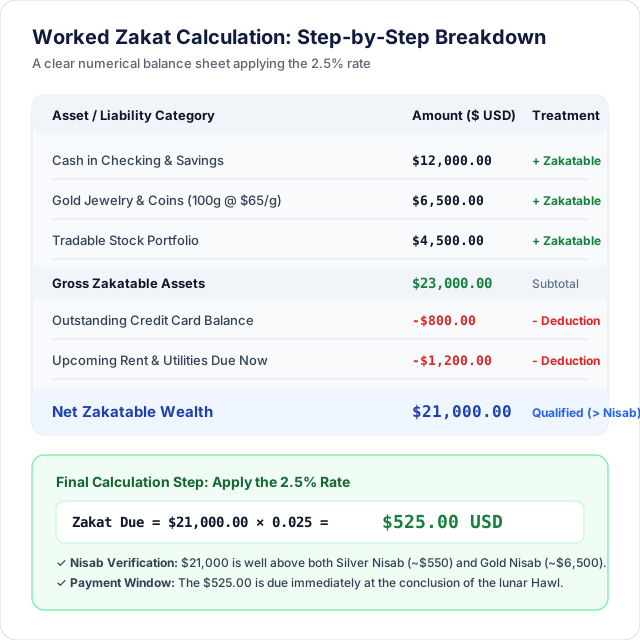
To illustrate how these principles apply in practice, let us examine a realistic household balance sheet on an individual's annual Zakat date:
| Category / Asset Description | Valuation ($ USD) | Classification & Treatment |
|---|---|---|
| Cash in Checking and Savings Accounts | $12,000.00 | 100% Zakatable liquid asset |
| Gold Jewelry & Coins (100 grams @ $65/g market price) | $6,500.00 | 100% Zakatable monetary metal |
| Tradable Stock Portfolio | $4,500.00 | 100% Zakatable active trading equity |
| Primary Residence (Home Market Value) | $380,000.00 | 100% EXEMPT (Personal living necessity) |
| Personal Family Vehicle | $24,000.00 | 100% EXEMPT (Daily personal transport) |
| Total Gross Zakatable Assets | $23,000.00 | Subtotal of qualifying surplus assets |
| Outstanding Credit Card Balance Due Now | -$800.00 | Deductible immediate liability |
| Next Month Rent and Utilities Due Immediately | -$1,200.00 | Deductible living expenses due now |
| Total Deductible Liabilities | -$2,000.00 | Subtotal of qualifying debts |
| Net Zakatable Wealth | $21,000.00 | ($23,000.00 − $2,000.00) |
Step-by-Step Mathematical Computation
- Verify Against Nisab: The current Silver Nisab (595g × $0.92/g) is approximately $547.40 USD. The Gold Nisab (85g × $65/g) is $5,525.00 USD. The individual's net wealth of $21,000.00 exceeds both thresholds by a substantial margin. Zakat is obligatory.
- Multiply by the 2.5% Rate:
Zakat Due = $21,000.00 × 0.025 = $525.00 USD
- Fulfillment: The $525.00 must be disbursed directly to eligible Zakat recipients without unnecessary delay.
How to Calculate Zakat on Gold Specifically
Because gold is frequently held in non-standard weights (such as tolas or sovereign coins) and alloyed purities (karats), calculating its cash value requires an extra conversion step.
Karat Purity Conversion Table
Pure gold is 24 karats (99.9% pure). Jewelry is usually blended with copper or silver to enhance durability. When calculating Zakat, you pay on the pure gold content only:
| Karat Purity | Gold Percentage | Purity Multiplier | Calculation Formula |
|---|---|---|---|
| 24 Karat (24K) | 99.9% Pure | 1.000 | Total Grams × 1.0 |
| 22 Karat (22K) | 91.6% Pure | 0.9167 | Total Grams × (22 ÷ 24) |
| 21 Karat (21K) | 87.5% Pure | 0.8750 | Total Grams × (21 ÷ 24) |
| 18 Karat (18K) | 75.0% Pure | 0.7500 | Total Grams × (18 ÷ 24) |
Worked Gold Example: Suppose you own 120 grams of 21K gold jewelry. The pure gold content is 120 × (21 ÷ 24) = 105 grams. If pure 24K gold is $65.00 per gram, the value for Zakat is 105 × $65.00 = $6,825.00. Zakat due on this gold alone is $6,825.00 × 0.025 = $170.63.
Step-by-Step Guide: Using the CoditTools Zakat Calculator
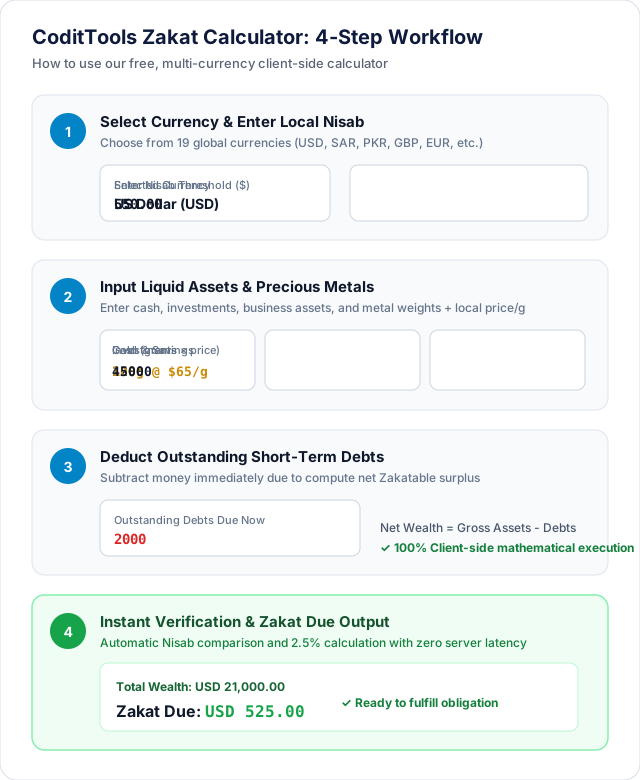
The CoditTools Zakat Calculator allows you to compute your Zakat liability in seconds with 100% client-side privacy. The tool runs locally in your web browser—no financial data is ever transmitted to a server or saved in a cloud database.
-
Select Currency:
Choose from 19 global currencies, including USD, SAR, AED, QAR, KWD, PKR, INR, BDT, GBP, EUR, CAD, and AUD.
-
Enter Your Local Nisab Threshold:
Because gold and silver spot prices change daily across international exchanges, look up today's local price for 85g of gold or 595g of silver in your chosen currency and enter the threshold value into the Nisab input box.
-
Enter Asset Categories:
Input your liquid figures across Cash & Savings, Gold (grams and price per gram), Silver (grams and price per gram), Investments, and Business Assets.
-
Input Outstanding Debts & Calculate:
Enter your short-term deductible liabilities into the Outstanding Debts field. Click Calculate Zakat to see your total net wealth and your exact 2.5% Zakat obligation displayed immediately.
Calculate Your Zakat Online in Complete Privacy
Input cash, gold, silver, investments, and business inventory across 19 global currencies with instant 2.5% calculation and zero data uploads.
7 Common Zakat Calculation Mistakes to Avoid
When computing annual obligations, taxpayers and savers frequently fall into several recurring traps:
-
Confusing Zakat with Income Tax or Voluntary Charity (Sadaqah):
Income tax paid to secular governments does not substitute for Zakat. Similarly, building mosques, funding schools, or general humanitarian gifts given during the year cannot be retroactively counted as Zakat unless they were intended as Zakat at the moment of payment and delivered to eligible recipients.
-
Deducting Long-Term Mortgage Principals:
Subtracting the full remaining balance of a multi-decade loan rather than the upcoming 12 months' installments will artificially create negative wealth and unlawfully evade the obligation.
-
Overlooking Business Inventory:
Entrepreneurs frequently pay Zakat on business bank accounts while omitting warehouses full of wholesale stock. Unsold goods intended for resale must be assessed at wholesale replacement value.
-
Failing to Adjust for Gold Karats:
Applying the 24K pure gold spot price directly to 18K or 21K jewelry causes you to overpay, while failing to discount alloy weight causes inaccuracy. Always adjust by the karat purity fraction.
-
Neglecting Bad Debts vs. Good Debts:
Expecting to pay Zakat on money lent to an uncollectible, bankrupt borrower is unnecessary; only pay on loans that are actively recoverable.
-
Ignoring Retirement Accounts:
Leaving vested, accessible 401(k) or IRA balances completely out of your calculations because retirement is years away. If the funds can be accessed (even after standard tax and early withdrawal penalties), the net accessible amount is Zakatable under contemporary rulings.
-
Giving Zakat to Ineligible Family Members:
Under Islamic law, you cannot give Zakat to direct ascendants (parents, grandparents) or direct descendants (children, grandchildren), nor to your spouse, because you are legally obligated to financially support them. However, poor siblings, aunts, uncles, cousins, and in-laws are not only eligible but preferred recipients (yielding a double reward for charity and maintaining family ties).
Frequently Asked Questions
Who is eligible to receive Zakat?
The Quran strictly defines eight eligible categories of Zakat recipients in Surah At-Tawbah (9:60): (1) The poor (al-Fuqara), (2) The destitute (al-Masakin), (3) Zakat administrators and collectors (al-Amilina Alayha), (4) Those whose hearts are to be reconciled (al-Mu'allafati Qulubuhum), (5) Freeing captives and enslaved persons (Fi al-Riqab), (6) Individuals overwhelmed by debt (al-Gharimin), (7) In the cause of God (Fi Sabilillah), and (8) The stranded traveler (Ibn al-Sabil).
What if my wealth drops below Nisab during the year?
Under the Hanafi school, if your wealth temporarily dips below Nisab mid-year but recovers and equals or exceeds Nisab on your annual Zakat date, your Hawl remains intact and you pay Zakat on the full balance present. Under the Shafi'i and Hanbali schools, if wealth drops below Nisab at any moment, the Hawl resets, and a new 354-day cycle begins when your wealth crosses Nisab again.
Is Zakat paid on salary or income as soon as it is received?
No. Zakat is not an income tax paid on monthly paychecks. You only pay Zakat on what remains unspent from your salary and has been saved for one full lunar year as part of your surplus wealth above Nisab.
Can I pay my Zakat in advance?
Yes. The majority of classical and contemporary scholars permit paying Zakat months in advance if your wealth has already crossed the Nisab threshold (for example, during Ramadan or in response to an urgent humanitarian disaster). On your official anniversary date, reconcile your accounts and disburse any remaining difference.
How does the CoditTools Zakat Calculator protect my privacy?
The CoditTools Zakat Calculator operates 100% inside your client-side web browser. No asset figures, currency selections, or calculated totals are ever sent across the network, stored in cookies, or saved on our servers. Your personal financial data remains strictly confidential on your device.
Conclusion & Best Practices
Fulfilling your Zakat obligation with mathematical accuracy and spiritual intentionality preserves the economic justice embedded in Islamic financial jurisprudence. By establishing a consistent annual Zakat date, carefully valuing all cash, metal, and commercial assets, and applying balanced deductions for immediate liabilities, you ensure your wealth is fully purified.
Whenever you need to calculate your annual dues, verify Nisab thresholds across global currencies, or evaluate complex asset holdings, bookmark the CoditTools Zakat Calculator and explore our full collection of financial utilities in the Finance Tools suite.
Try the tools mentioned in this post - all free, no account needed.
Runs in your browser. No watermarks. No file uploads to a server.
Browse all tools →