How to Count Sentences: Delimiter Rules, Run-On Detection & Optimal Sentence Length
Learn how to count sentences accurately using proper delimiter rules. Explore abbreviation edge cases, decimal handling, optimal words per sentence, and run-on diagnosis.

Whether you are polishing an academic essay, drafting a high-converting landing page, or auditing technical documentation for plain-language compliance, sentence structure determines how easily readers absorb your ideas. When sentences stretch beyond thirty or forty words without clear syntactic hierarchy, working memory falters and comprehension collapses. Conversely, relying exclusively on five-word fragments produces a jarring, staccato rhythm that feels robotic.
A sentence counter is an analytical text utility that breaks raw prose into discrete grammatical units to measure sentence totals, evaluate average words per sentence, and identify overly complex passages. While counting words is relatively straightforward, counting sentences accurately is one of the classic challenges of computational linguistics. A naive parser that simply splits text at every period will miscalculate every time it encounters an abbreviation like Dr., a decimal like 3.5, an email address, or a numbered list.

Quick Answer: How Do You Count Sentences in a Paragraph?
To count the number of sentences in any passage by hand or programmatically, follow these four foundational rules:
- Identify Terminal Punctuation: Locate every period (
.), exclamation mark (!), question mark (?), and terminal ellipsis (…) that is followed by whitespace or the end of the text. - Filter Out Protected Abbreviations: Ignore periods that immediately follow titles (such as Mr., Mrs., Ms., Dr., Prof.) or Latin markers (such as e.g., i.e., and vs.). These are lexical abbreviations, not clause boundaries.
- Protect Decimals, Web Domains, and Numbers: Never split on periods embedded inside digits (such as
$19.99or3.5), software release numbers (such asv2.1.3), URLs (such ascodittools.com), or list numerals at the start of a line (such as1. Introduction). - Account for Quotation Marks and Brackets: When dialogue or parenthetical citations end a sentence, the closing quotation mark or parenthesis belongs to the preceding sentence (for example, He whispered, "Goodbye." Then he walked away. contains exactly two sentences).
If you need to analyze a draft instantly, you can paste your text directly into the free CoditTools Sentence Counter. The tool executes entirely inside your browser using client-side JavaScript, computing your exact sentence count, average words per sentence, reading duration, and longest sentence without uploading your writing to any remote server.
What Truly Constitutes a Sentence?
From a grammatical perspective, a complete sentence expresses a unified, independent thought. In formal English, a standard sentence requires at minimum an explicit or implied subject and a finite predicate verb:
The Anatomical Building Blocks of a Sentence
- Subject: The person, place, entity, or concept performing the action or being described (e.g., The algorithm).
- Predicate: The finite verb phrase asserting what the subject does or experiences (e.g., processes the text instantly).
- Independent Clause: A grammatical structure that expresses a complete thought and can stand alone as a coherent statement.
- Imperative Exception: A complete sentence can consist of a single imperative verb where the subject "you" is understood (e.g., "Wait!" or "Listen.").
However, an automated sentences counter operates on punctuation mechanics rather than semantic understanding. A tokenizer cannot know whether a writer accidentally omitted a main verb or strung together incomplete thoughts; it relies on punctuation delimiters to segment text into syntactic units. Understanding this boundary between grammatical syntax and mechanical punctuation is essential for diagnosing stylistic issues in your writing.
How Sentence Counting Differs from Counting Periods
A widespread misconception among beginner writers and programmers is that counting sentences is simply a matter of tallying up the periods in a document. In real-world English prose, periods serve multiple distinct typographic and orthographic functions that have nothing to do with ending a sentence.
Consider the following test passage:
If you count the periods in that passage, you will find nine periods:
- One inside
Dr. - Two inside
a.m. - One inside
2.5 - One inside
example.com - One inside
$4.99 - Two inside
e.g. - One after
Yes.
Yet the passage contains only four sentences:
- "Dr. Smith arrived at 8:30 a.m. to review version 2.5 of the software on example.com." (Ends with a period followed by space and capital The).
- "The dataset cost $4.99, e.g., less than a coffee!" (Ends with an exclamation point).
- "Did she approve it?" (Ends with a question mark).
- "Yes." (Ends with a period).
A naive period-counting algorithm would report nine sentences, overestimating the true sentence count by more than 125%. Accurate sentence counting requires robust delimiter boundary validation that distinguishes abbreviations, numerical formats, and nested punctuation from true terminal markers.
Sentence-Boundary Edge Cases and Delimiter Mechanics
To accurately segment English prose, the tokenizer behind the CoditTools Sentence Counter applies specific boundary validation logic across four distinct categories of text elements.
1. Unconditional Abbreviations and Honorific Titles
Certain abbreviations are followed by a period as a matter of orthography, but they never conclude a sentence when appearing before a name or technical modifier. These include:
- Social and Academic Titles:
Mr.,Mrs.,Ms.,Mx.,Dr.,Prof.,Rev.,Hon. - Military Titles:
Gen.,Col.,Lt.,Sgt.,Capt. - Latin Scholarly Markers:
e.g.(for example),i.e.(that is),vs.(versus),cf.(compare),viz.(namely).
Because these tokens are followed by continuation text rather than a sentence boundary, the tokenizer checks against an internal dictionary of non-splitting terms. A sentence such as "Please consult Dr. Watson regarding the results." is correctly preserved as a single sentence.
2. Conditional Abbreviations (Context-Dependent Endings)
Other abbreviations can function either in the middle of a clause or at the very end of an independent statement. These include business designations (Inc., Ltd., Corp., Co.), temporal markers (a.m., p.m.), geographic acronyms (U.S., U.K.), degrees (Ph.D., M.D.), and miscellaneous terms (etc., al., approx., dept., vol., no.).
To resolve these ambiguities, modern tokenizers evaluate the capitalization of the following token:
- Mid-Sentence: "The meeting begins at 9 a.m. sharp in conference room B." Because sharp is lowercase, the period after a.m. is recognized as an abbreviation marker, not a sentence boundary (1 sentence).
- Terminal Position: "The meeting begins at 9 a.m. Please arrive five minutes early." Because Please begins with an uppercase letter, the period after a.m. serves a dual role: it completes the abbreviation and terminates the sentence (2 sentences).
3. Single-Letter Initials and Middle Names
When writers mention names with initials, such as J. K. Rowling, George R. R. Martin, or W. E. B. Du Bois, single uppercase letters followed by periods must not trigger sentence splits. The boundary engine inspects whether the capitalized letter is followed immediately by another initial or a capitalized surname. If an initial appears as the final word of an independent clause (for example, "He was identified only as Officer K. The chief declined further comment."), the capitalization of the subsequent word correctly flags the boundary.
4. Decimals, Web Addresses, Versions, and Numbered Outlines
In standard typography, sentence delimiters are followed by whitespace or line breaks. Numerical decimals (3.14159), currency values ($49.95), web hostnames (codittools.com), and software build numbers (v16.4.2) do not have whitespace following their internal periods. By enforcing the regex pattern (?=\\s|$), these tokens are inherently immune to false splits.
Similarly, numbered list markers at the start of a line (such as 1. First step\\n2. Second step) are protected by line-start position checks. This prevents ordered outlines from inflating sentence counts prematurely.
How to Calculate Average Sentence Length
Average sentence length measures the mean number of words per sentence across a passage. It is one of the most reliable mechanical proxies for syntactic density and reading effort.
The Mathematical Formula
Average Sentence Length (Words / Sentence) = Total Words in Text ÷ Total Number of Sentences
Total Words: All whitespace-separated word tokens containing alphanumeric characters.Total Sentences: Count of valid delimited sentence segments.
- Empty inputs or whitespace-only strings evaluate to
0sentences and0.0average length. - Result is standardized to one decimal place (e.g.,
18.4words/sentence).
Worked Calculation Example
Suppose you are evaluating a short introductory section containing 84 words divided across 4 sentences:
If you edit the draft to split a long 36-word sentence into two 18-word sentences, the total word count remains 84, but your sentence count increases to 5:
By making that single structural change, you reduce the average sentence length by 4.2 words, immediately easing cognitive processing for your readers.

Sentence Length and the Cognitive Readability Spectrum
How long should a sentence be? Extensive reading research conducted by usability institutes, educational researchers, and government plain-language initiatives demonstrates a direct correlation between sentence length and reading comprehension:
| Sentence Length Band | Estimated Comprehension | Cognitive Effort | Ideal Practical Context |
|---|---|---|---|
| < 10 words | > 95% | Near zero | Hero value propositions, emphatic transitions, mobile calls to action. |
| 11–15 words | 90%–95% | Very low | Consumer blog posts, marketing emails, plain-language customer guides. |
| 16–20 words | 80%–90% | Balanced | The golden standard for technical articles, journalism, and business correspondence. |
| 21–29 words | 65%–80% | Moderate | Academic publications, analytical essays, legal qualifications with subordinate clauses. |
| 30+ words | < 50% on first pass | High / Overload | Frequently indicates unpunctuated run-ons or comma splices; candidates for division. |
The Importance of Rhythmic Variety
While maintaining an average sentence length between 15 and 20 words is optimal for web and business reading, you should never attempt to make every individual sentence exactly eighteen words long. Good prose requires rhythmic texture. A sequence of uniformly medium sentences quickly becomes monotonous.
Consider the cadence recommended by master stylists: pair a short, decisive statement (5–8 words) with an explanatory compound sentence (18–22 words), followed by an illustrative subordinate clause (12–16 words). This natural ebb and flow engages the reader's inner ear while keeping overall readability high. For broader document metrics, you can combine sentence metrics with our Word Counter and Words to Pages guide.
Diagnosing Run-On Sentences vs Mechanical Counts
One of the most critical distinctions in text analysis is understanding what an automated sentence counter can and cannot detect regarding run-on sentences.
What a Sentence Counter Actually Does
- Mechanical Counting: The tool scans for explicit punctuation delimiters (
.,!,?,…) and groups text segments accordingly. - Longest Sentence Diagnostic: It identifies the longest sentence by character and word count, highlighting where your writing is densest.
- Grammar Limitation: The tool cannot parse grammatical relationships or automatically identify comma splices. If a writer pastes two independent clauses joined only by a comma, the counter will report it as a single sentence because no terminal punctuation exists.
The Two Types of Run-On Sentences
- Fused Sentence: Two independent clauses joined with zero punctuation (e.g., "The server went down nobody could access the database."). Because there is no terminal mark, a sentence counter counts this as one sentence, even though it contains two distinct grammatical statements.
- Comma Splice: Two independent clauses joined by a comma without a coordinating conjunction (e.g., "The server went down, nobody could access the database."). Because commas are internal phrase markers, the tokenizer correctly ignores the comma and reports one sentence.

Three Ways to Revise a Run-On Sentence
When the CoditTools Sentence Counter highlights an unusually long sentence in your draft, inspect it for unjoined clauses. You can fix it using three established techniques:
-
Method 1: The Period Split: Place a period at the end of the first independent clause and capitalize the second.
"The server went down. Nobody could access the database."
Best for: Maximum clarity, quick reading, and strong emphasis. -
Method 2: Semicolon and Conjunctive Adverb: Join the clauses with a semicolon, followed by a transition word like however, consequently, or therefore, followed by a comma.
"The server went down; consequently, nobody could access the database."
Best for: Preserving a close causal or comparative link between two thoughts. -
Method 3: Subordinating Conjunction: Convert one of the independent clauses into a dependent clause using a conjunction such as because, since, although, or while.
"Because the server went down, nobody could access the database."
Best for: Professional writing where you want to show logical hierarchy rather than presenting clauses as isolated facts.
Worked Example: Complete Sentence Breakdown of a Real Paragraph
To see how boundary detection, word counts, and average length work together in practice, let us examine an editorial paragraph containing several challenging edge cases:
Step-by-Step Segmentation Analysis
"Dr. Adams published the paper on Oct. 15, 2025."
Delimiter Analysis: The period inside Dr. is ignored as an honorific title. The period inside Oct. is followed by a number (15), confirming it is an abbreviation. The terminal period after 2025. triggers the sentence break.
"It evaluated version 3.2 of the data pipeline on codittools.com, noting a 14.8% reduction in latency!"
Delimiter Analysis: 3.2, codittools.com, and 14.8% have no trailing whitespace, preventing premature splits. The exclamation mark ! serves as the terminal delimiter.
"Did the engineering team adopt the findings?"
Delimiter Analysis: Standard interrogative statement terminated cleanly by the question mark ?.
"Yes, and Dr. Adams stated, 'We saw immediate improvements.'"
Delimiter Analysis: Dr. is protected. The period inside the quotation mark is recognized as the clause boundary; the closing quotation mark ' is absorbed with the punctuation delimiter.
"The deployment was a complete success."
Delimiter Analysis: Final declarative sentence terminated by standard period.
Quantitative Summary
- Total Sentences: 5 sentences.
- Total Word Count: 51 words.
- Average Sentence Length: 51 ÷ 5 = 10.2 words per sentence.
- Longest Sentence: Sentence 2 (17 words / 106 characters).
- Estimated Reading Time: 51 ÷ 200 = 0.255 minutes → 16 seconds.
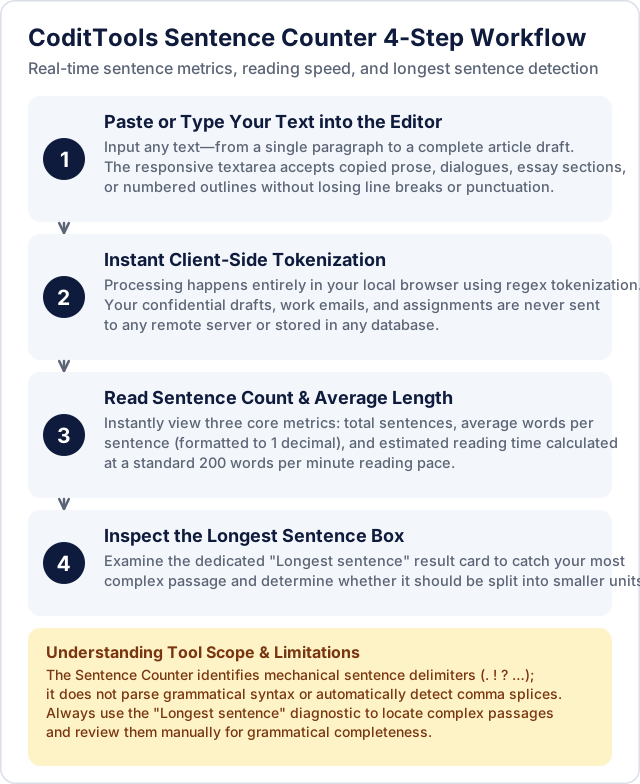
Step-by-Step Guide: Using the CoditTools Sentence Counter
You can analyze any document in seconds without registering an account, installing browser plugins, or uploading confidential writing to cloud servers. Here is how the CoditTools Sentence Counter functions step by step:
-
Paste or Type Your Text:
Copy your text from Microsoft Word, Google Docs, an email draft, or your code editor and paste it directly into the input textarea. The tool handles everything from a quick headline to a multi-thousand-word manuscript.
-
Automatic Client-Side Tokenization:
As you type or paste, the client-side JavaScript engine executes instantaneously. It evaluates periods against non-splitting sets (such as Dr., e.g., and i.e.), inspects conditional abbreviations, and skips decimals without making a single server call.
-
Read Instant Diagnostic Metrics:
Three primary metric cards update immediately above the editor:
- Sentences: Total count of verified sentences.
- Avg Words / Sentence: Mean word count per sentence formatted to one decimal place.
- Reading Time: Estimated time required to read the passage at a standard rate of 200 words per minute (displayed in seconds for short passages or minutes for longer documents).
-
Inspect the Longest Sentence Card:
Review the dedicated "Longest sentence" display box below the metric cards. This surface isolates your draft's most character-dense statement so you can immediately see whether it represents a graceful compound thought or an accidental run-on sentence that needs restructuring.
Analyze Your Sentences in Real Time
Inspect sentence counts, average sentence length, reading time, and longest sentences with zero server uploads and total privacy.
5 Common Sentence-Counting Mistakes Writers Make
When writers attempt to audit sentence density manually or rely on basic word processor counters, five common pitfalls frequently skew their results:
-
Treating Semicolons and Colons as Sentence Terminators:
Grammatically, a semicolon joins two closely related independent clauses into one compound sentence. Colons similarly introduce elaborations or lists within the parent statement. Counting semicolons as full stops will artificially inflate your sentence count and give a false impression of brevity.
-
Assuming Word Count Correlates Directly with Sentence Count:
Two articles can each contain exactly 1,000 words, yet one may have 40 sentences (averaging 25 words per sentence, creating heavy cognitive load) while the other has 70 sentences (averaging 14 words per sentence, yielding crisp readability). Never assume a low word count guarantees readability without measuring sentence distribution.
-
Over-Correcting into Monotonous Staccato Prose:
Upon discovering that their average sentence length is high, some writers edit every single sentence down to eight or ten words. While each individual sentence is easy to read, the overall text becomes choppy and loses its natural cadence. Aim for an overall average of 14–20 words while keeping individual sentences varied between 6 and 28 words.
-
Ignoring Dialogue Punctuation Conventions:
In quoted dialogue, punctuation often sits inside the quotation mark: "We are ready," she announced. A simple period search might count this as zero or confuse commas with periods. In contrast, "We are ready." She smiled. contains two distinct sentences. A robust tokenizer correctly accounts for trailing quotation marks without splitting dialogue tags.
-
Assuming English Delimiters Apply to Non-Latin Scripts:
Standard Western tokenizers search for Latin terminal marks (
.,!,?). Languages such as Chinese and Japanese use full-width ideographic full stops (。), Arabic and Urdu use inverted question marks and unique full stops (،,۔), and Devanagari uses the danda (।). The CoditTools Sentence Counter is currently optimized for English and Latin-script punctuation conventions.
Frequently Asked Questions
What is an online sentence counter?
An online sentence counter is a browser-based text analysis tool that calculates the exact number of sentences in a given passage. Beyond raw counts, advanced counters like CoditTools compute average words per sentence, estimate reading duration, and isolate the longest sentence to assist with readability audits.
How many sentences are typically in a 100-word paragraph?
In standard clear English writing with an average sentence length of 15 to 20 words, a 100-word paragraph typically contains 5 to 7 sentences. In highly technical or legal writing where sentences average 25 words, 100 words may contain only 4 sentences.
Can a single word count as a complete sentence?
Yes. In English grammar, an imperative verb phrase where the subject "you" is understood forms a complete, grammatically valid sentence. Common single-word imperative sentences include "Halt!", "Wait.", "Run!", and "Look." A sentence counter recognizes these whenever they are followed by terminal punctuation.
How do you count sentences in Microsoft Word or Google Docs?
In Microsoft Word, you can enable "Show readability statistics" in Word Options under Proofing; after running a spelling and grammar check, Word displays a summary dialog showing total sentences and average words per sentence. In Google Docs, the built-in Word Count tool (Ctrl+Shift+C) shows pages, words, and characters, but does not display sentence counts, making an online counter necessary.
Does a semicolon create a new sentence?
No. A semicolon links two grammatically complete independent clauses into a single compound sentence. Because a semicolon indicates a closer conceptual connection than a full period, sentence counters do not split at semicolons.
Why does my sentence count vary between different online tools?
Sentence counts vary across tools because different tokenizers use different dictionaries for abbreviation handling. Basic tools split at every period, inflating counts whenever titles (Dr., Mr.) or decimals (3.5) appear. Sophisticated tools like CoditTools apply boundary regex logic and conditional abbreviation lists to prevent false splits.
Does CoditTools store or upload my text when counting sentences?
No. The CoditTools Sentence Counter processes all text strictly inside your client browser using native JavaScript regex functions. Your essays, emails, legal drafts, and creative writing are never sent across the network, stored in databases, or logged on remote servers.
Conclusion
Accurate sentence counting is the cornerstone of structural editing and readability optimization. By understanding the mechanical rules of sentence delimitation—protecting abbreviations, insulating numerical decimals, and properly evaluating conditional acronyms—you can gain clear insight into the syntactic rhythm of your writing.
Monitoring your average sentence length helps you hit the sweet spot between concise impact and nuanced exposition. Whenever you need to audit an essay, optimize a web landing page, or verify sentence metrics, bookmark the CoditTools Sentence Counter and explore our complementary utilities, including the Word Counter and our complete Text Tools suite.
Try the tools mentioned in this post - all free, no account needed.
Runs in your browser. No watermarks. No file uploads to a server.
Browse text tools →