How Long Will It Take to Pay Off a Credit Card? Formula, Minimum Payments and Extra Payments
How long a credit card takes to pay off depends on balance, APR and payment. The formula, a worked $3,500 example, minimum-payment cost and extra-payment savings.
How long a credit card takes to pay off depends on three numbers: the balance, the interest rate and the monthly payment. The payment has to be larger than the interest charged each month, and every dollar above that reduces the balance. On a $3,500 balance at 24% APR, paying $150 a month clears the card in 32 months and costs $1,261.84 in interest. Paying $75 a month takes 137 months, more than 11 years, and costs $6,756.54.
Every figure in this guide was produced by the same code that runs the CoditTools Credit Card Payoff Calculator, using its default values ($3,500, 24% APR, $150 a month), so you can reproduce each one there. The calculator is a simplified model for planning. It does not copy any issuer's billing method, and it is not financial advice: your statement is what your issuer actually charges.
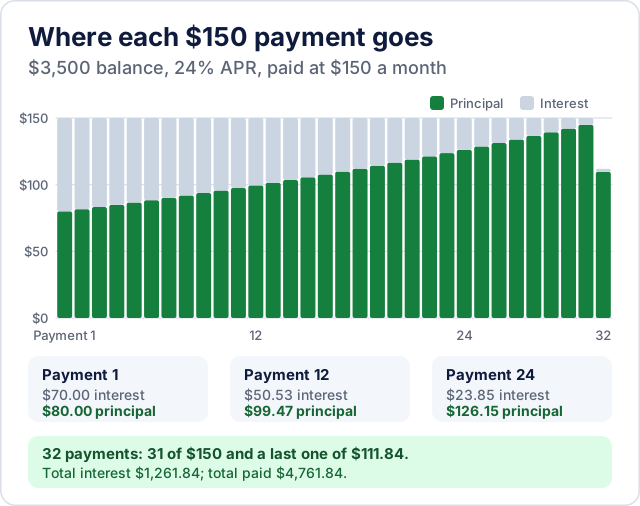
How each payment is split between interest and balance
In the calculator's model, each month the card charges interest on what you still owe, and your payment pays that interest first. Only the rest reduces the balance. The calculator turns the APR into a monthly rate by dividing it by 12, so 24% a year is 2% a month. On $3,500 that is $70.00 of interest in the first month, which leaves $80.00 of a $150 payment for the balance. This flat monthly rate is a simplification: many issuers charge interest daily, so the interest on your own statement can differ from this table (see the last section).
| Payment | Paid | Interest (balance × 2%) | Reduces balance | Balance after |
|---|---|---|---|---|
| 1 | $150.00 | $70.00 | $80.00 | $3,420.00 |
| 2 | $150.00 | $68.40 | $81.60 | $3,338.40 |
| 3 | $150.00 | $66.77 | $83.23 | $3,255.17 |
| 12 | $150.00 | $50.53 | $99.47 | $2,427.03 |
| 24 | $150.00 | $23.85 | $126.15 | $1,066.25 |
| 31 | $150.00 | $5.09 | $144.91 | $109.64 |
| 32 | $111.84 | $2.19 | $109.64 | $0.00 |
The payment never changes, but its make-up does. In the first 12 payments, $727.03 of the $1,800 you pay is interest and $1,072.97 reduces the card. The last payment is smaller ($111.84) because only $109.64 is left to clear. Over the whole payoff you pay $4,761.84, which is the $3,500 plus $1,261.84 of interest.
The payoff-time formula
You can work out the number of payments without a month-by-month table:
n = −ln(1 − B × r ÷ P) ÷ ln(1 + r)

B = balance          r = monthly rate (APR ÷ 12, as a decimal)
P = monthly payment  n = number of payments
For the example, B × r = 3,500 × 0.02 = 70, so 1 − 70 ÷ 150 = 0.5333. Then n = −ln(0.5333) ÷ ln(1.02) = 0.6286 ÷ 0.0198 ≈ 31.74. That means 31 full payments and a smaller 32nd one, which matches the table above.
The formula only works when the payment is larger than the first month's interest (B × r). If P is $70 or less, the term inside the logarithm is zero or negative and the balance never goes down. The calculator tells you so when the payment does not cover the interest. It also assumes a constant APR, a constant payment, no fees and no new purchases. At 0% interest it simplifies to the balance divided by the payment.
How much the payment size changes the answer
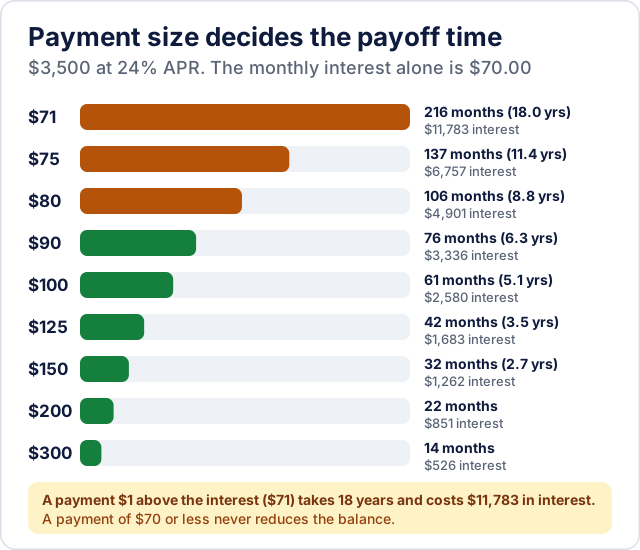
Because the interest is charged on the whole balance every month, payments close to the interest amount barely move it. On the same $3,500 at 24% APR:
| Monthly payment | Months to pay off | Years | Total interest |
|---|---|---|---|
| $71 | 216 | 18.0 | $11,783.47 |
| $75 | 137 | 11.4 | $6,756.54 |
| $100 | 61 | 5.1 | $2,580.02 |
| $150 | 32 | 2.7 | $1,261.84 |
| $200 | 22 | 1.8 | $851.13 |
| $300 | 14 | 1.2 | $525.99 |
| $500 | 8 | 0.7 | $309.32 |
A payment of $71, a dollar above the $70 of first-month interest, takes 18 years and costs more than three times the original balance in interest. Halving $150 to $75 does not double the time: it makes it more than four times as long (137 months instead of 32).
The rate matters too, but in this example the payment moves the date more. At $150 a month, a 15% APR clears the card in 28 months with $664.07 of interest, 20% takes 30 months ($969.32), 24% takes 32 ($1,261.84) and 29.99% takes 36 ($1,817.58). Going from 15% to 29.99% adds 8 months; cutting the payment from $150 to $100 adds 29.
The minimum-payment trap
There is no single minimum-payment rule: each issuer sets its own formula in the cardholder agreement. One example is a Synchrony Bank agreement for Gap cards, filed with the CFPB (PDF, created in 2016, so current terms may differ), which sets the minimum as the greater of $25 or the sum of any past-due amount, 1% of the new balance, late fees and the interest charged in the cycle, rounded up to a whole dollar. Other issuers use other percentages, dollar floors and add-ons, so check your own agreement. Where a minimum is tied to the balance, it shrinks as the balance falls. That is why paying only the minimum can take so long: the payment gets smaller exactly when the debt does.
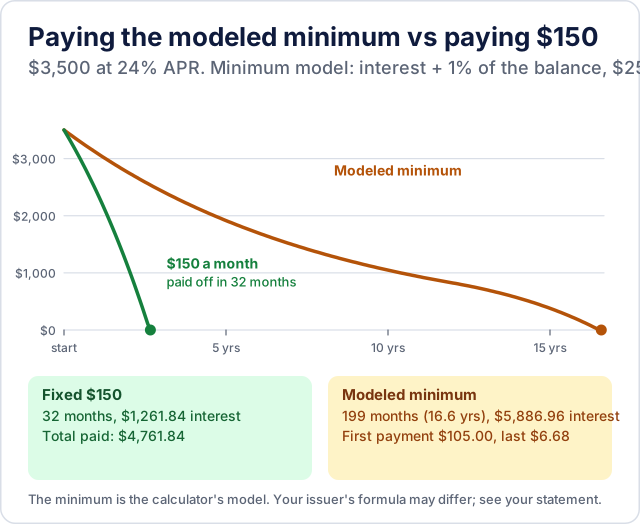
The calculator's Modeled Minimum Payment option uses a default of the month's interest plus 1% of the balance, with a $25 floor. You can change the percentage, the floor and the formula. It resembles the structure of the example above but leaves out fees, past-due amounts and rounding, and it is not any particular issuer's rule. On the $3,500 example it works out like this:
- The first payment is $105.00, and it falls to $94.01 by payment 12, $58.03 by payment 60 and $31.75 by payment 120. From payment 144 on, the $25 floor applies, and the last payment is $6.68.
- The card is paid off in 199 months (16.6 years) with $5,886.96 of interest, so you pay $9,386.96 in total, about 2.7 times the balance.
- Compared with a fixed $150 a month, that is 167 months longer and $4,625.12 more interest.
The calculator's other formula, "% of balance only", behaves differently. With 1% of the balance and a 24% APR, the payment is smaller than the 2% monthly interest, so the calculator reports that the balance will not go down. Whether a real minimum covers the interest depends on how your issuer defines it, so check your own terms.
In the United States, the statement itself answers the question for your card. The Consumer Financial Protection Bureau explains that issuers must show how long it would take to pay off the balance if you paid only the minimum and made no new charges, and how much you would need to pay each month to clear the balance in 36 months (CFPB, last reviewed January 2024). For this example the calculator's 36-month payment is $137.32, a quick way to check that your inputs match your statement.
What an extra payment saves
Anything above the regular payment goes straight to the balance, so less interest builds up in every later month. Against the plain $150-a-month plan (32 months, $1,261.84 of interest):
| Change | Months to pay off | Months saved | Interest saved |
|---|---|---|---|
| Extra $25 every month ($175 in total) | 26 | 6 | $247.28 |
| Extra $50 every month ($200 in total) | 22 | 10 | $410.71 |
| One extra $500 with the first payment | 26 | 6 | $375.81 |
The single $500 saves $375.81, almost as much as $50 extra every month ($410.71), because it reaches the balance in the first month and the interest on those $500 never builds up. It shortens the plan by the same six months as an extra $25 a month. A smaller amount repeated every month keeps cutting the balance for as long as you keep paying it, so over time it can save more than a one-off.
A note on rounding. The calculator subtracts the unrounded interest totals and rounds only the result. If you subtract the rounded totals yourself, the answer can differ by a cent. For the extra $25 the totals are $1,261.84 and $1,014.55, which subtract to $247.29, but the calculator's saving is $247.28. For the one-off $500 the totals are $1,261.84 and $886.02, which subtract to $375.82, against the calculator's $375.81.
Working backwards from a payoff date
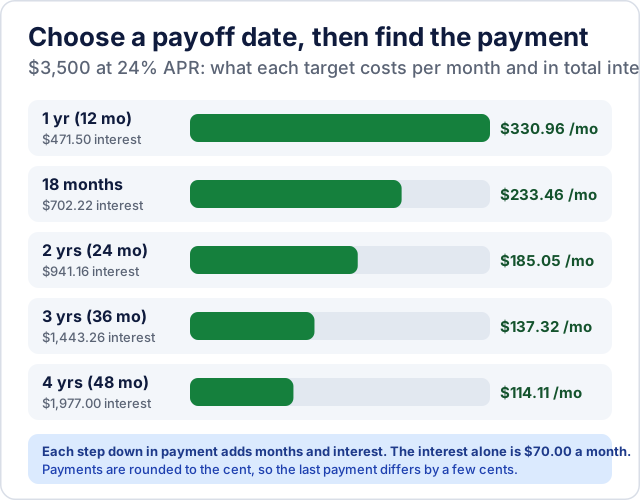
If you would rather pick the date first, the calculator's Target Payoff Time mode solves for the payment. It uses the standard fixed-payment formula, so it assumes the same things as the formula above:
| Target | Monthly payment needed | Total interest |
|---|---|---|
| 12 months | $330.96 | $471.50 |
| 18 months | $233.46 | $702.22 |
| 24 months | $185.05 | $941.16 |
| 36 months | $137.32 | $1,443.26 |
| 48 months | $114.11 | $1,977.00 |
Each target is a trade-off between a larger payment and a larger interest bill. Payments are rounded to the cent, so the final payment differs by a few cents. A card has no fixed term, which is the difference from an instalment loan: the loan's payment is set by its term, as in the EMI guide, while a card payment is whatever you choose to pay. If a payment is more than your budget allows, the 50/30/20 Budget Calculator splits after-tax income into needs, wants and savings, which gives a starting point for how much could go toward debt payments.
What this estimate leaves out
- How your issuer calculates interest. The calculator charges a flat monthly rate (APR ÷ 12) on the balance left after each payment. Many issuers work differently. The CFPB explains that many issuers calculate interest daily on the average daily balance (CFPB, last reviewed January 2024), and that a daily periodic rate is the APR divided by 360 or 365 depending on the issuer, with the interest compounding daily (CFPB, last reviewed September 2024). When your payment posts, how many days are in the cycle and whether interest compounds daily can all move the interest charged, so your statement can show more or less than this model. This guide does not measure that difference.
- Grace periods. Per the CFPB, a grace period usually applies only to new purchases, and only if you were not already carrying a balance. The calculator has no grace-period setting.
- New purchases. Every figure assumes you stop using the card. New charges add to the balance and can cancel out the payments.
- One card, one rate. The calculator handles a single card at a constant APR. A variable rate, a balance transfer or a promotional rate needs a separate calculation for each period, and "deferred interest" offers have their own rules.
- Fees and late payments. Late fees, penalty rates and annual fees are not included.
- Very long payoffs. The calculator stops at 600 months (50 years). A payment that only just covers the interest can hit that limit.
To try your own numbers, enter the balance and APR from your latest statement in the Credit Card Payoff Calculator, then compare your usual payment with the modeled minimum or with a target date. The finance calculators guide covers the other calculators and what each one assumes.
Try the tools mentioned in this post - all free, no account needed.
Runs in your browser. No watermarks. No file uploads to a server.
Browse finance calculators →